
Gurmat - The art of spiritual wisdom

This essay by Khushwant Singh draws on Gurmat, timeless wisdom, to explain the deeper causes of human suffering, social division, and environmental destruction. It examines the relationship between consciousness and unconsciousness, mind, soul, ethics, and wellbeing from a holistic perspective. The article shows that sustainable transformation and healing begin with honest introspection and the courage to change course, both individually and collectively.
Credits: Unsplash
How peace from mind through knowledge of the soul can help overcoming the challenges of humankind
I’m gonna make a change, for once in my life
It’s gonna feel real good, gonna make a difference
Gonna make it right …
I’m starting with the man in the mirror
I’m asking him to change his ways
And no message could have been any clearer
If you wanna make the world a better place …
– Man in the Mirror, 1987
Eighty percent of people say they belong to a religion – and as religions inspires their followers to do good – why isn’t our world better? The natural beauty of Mother Earth already makes it a wonderful place by itself. Yet, once humans are added to the equation, we see that all of the virtues that religions claims to encourage – humility, justice, solidarity, farsightedness, and a loving relationship with our fellow beings and nature – are not prevailing on Earth. How can we then speak of ourselves as developed, let alone good?
Why peaceful visitors from another galaxy would stay only short while
Evolution has always be an integral part of life. And since the onset of industrialisation, the Earth has especially been undergoing decisive changes. There is little doubt that an observer from another galaxy would acknowledge the cultural, medical, infrastructural and technological achievements of our world. But, by comparing the present condition of the planet with its magnificence before human beings began ‘cultivating’ it, the witness would point out that we have paid a high price. We are the only species on the Earth that is capable of destroying the whole planet – either quickly with atomic war or slowly through the destruction of the environment. We are the only species that restricts its fellow’s rights. We are the only species that limits access to basic needs like food, water and health services by a system of remuneration. And, we are the only species that causes suffering through undignified treatment, prejudices, deceit, discrimination on the grounds of origin or religion, the denial of free speech, psychological torture and even violence and abuse.
There are many other critical examples an outside observer could point to. We consume resources faster than our planet can renew them. The wonder of biodiversity is fading away on both land and under water. More and more poison enters into the biological cycle every second. And, to satisfy our desire for cheap food products, deforestation, livestock farming and the use of genetically modified foods, and hormones have become normal.
Approximately two billion people live in contexts of fragility and conflict. Violence causes more than 1 million deaths every year. Human rights violations are prevalent in all parts of the world. More than 50 percent of the world’s population live on less than a few Euros per day. The richest 20 percent of the world’s population consume 80 percent of all resources. The wealthiest one percent owns more than the rest of all other people together. Nonetheless, most nations continue with interest-led policies in the same way as rich business people, shareholders and multinational corporations carry on to maximise their profits without having much ethical concerns for society and the environment. Using loopholes for ‘legal’ tax breaks is a widely acknowledged practice even after major financial crises. At the same time, more and more people see no other option than to leave their homes and immigrate due to poverty and violence. Conspicuous is that refugees and displaced people mainly find shelter in poor neighbouring regions, and not with countries whose riches are clearly tied to colonial pasts and the on-going practice of exploiting natural resources in so-called ‘developing countries’.
Side effects: A spoiled seed never produces a beautiful flower
Why has a spoiled seed never produced a beautiful flower? Because it is against the laws of nature.[1] Similarly, the supposedly ‘developed’ lifestyle of material affluence and recklessness has created neither more justice nor peace from mind. The number of people suffering from loneliness, depression, insecurities, performance pressure, obesity, chronic maladies, and diseases like cancer is increasing. Excessive consumption of meat, unhealthy industrial processed foods, alcohol and cigarettes, as well as using hormones is widely socially accepted. More and more people are permanently stressed. It has even become a signifier for being ‘successful’. Closely linked is the rise of a “throw-away” and “the grass is always greener” mentality as the growing number of affairs and divorces illustrates.[2]
Aftereffects of the internet
A new factor that is decisively changing our lives is the Internet. Its achievements are outstanding. At the same time, it reinforces disorientation and hyper-individualisation. It has created space for superficial exchange and self-expression. The dissemination of shallow or fake news, inhumane and denunciatory content that even glorifies violence – often well protected behind the walls of anonymity – contributes to the decline of a quality oriented and respectful discussion culture, and in the worst case: it leads to hatred and violence. The free access to pornography is also problematic. Women feel a growing pressure to conform to the beauty ideals of models who edit not only their pictures, but also edit their bodies surgically and put themselves on display on the web.
It has also become more difficult to consciously be present in the now, and to have a meaningful and uninterrupted conversation because we let ourselves be permanently distracted by mobile devices. We are continuously craving for the next visual, sensory and emotional highlight.
We cannot solve a problem at the same level it has come from
Despite the well-known fact that prevention is better than cure, human history shows that we are prone to repeat our mistakes.[3] Yet, the ostensible side effects of the current ‘western’ lifestyle have not discouraged ‘developing’ countries from striving for a similar consumption-oriented lifestyle. As the ecological footprint of developing counties expand, we are faced with a dire reality: if the world’s seven billion people all live according to current ‘western standards’, we will need five earths for sufficient resources.
Political, social and religious debates about why a large proportion of people still face existential challenges, although sufficient wealth is available, remain side issues. Although there are well-functioning technologies in the field of renewable energies, nuclear and fossil forms of energy production are still dominant energy suppliers.
It is a source of hope that slowly, more people are becoming aware of the challenges illustrated. It is encouraging that efficiency and economic growth are being questioned as the only solutions to the world’s problems. Politicians are being asked more and more to evolve from a predominantly interest to a value-oriented governance culture. Incoherence in politics is also being steadily exposed, for example, when governments criticise human rights valuations while exporting weapons to countries that oppress minorities. It is also laudable that climate summits are held, and that nearly all countries agreed to achieve the UN Sustainable Development Goals (SDGs) of the 2030 Agenda. But as long as there are no legally binding sanctions for those who fail to achieve these goals, it remains a well-intentioned exercise. Furthermore, it is problematic that the current values and systemic assumptions - foremost the growth paradigm along with measuring development purely based on the gross national product (GNP) - are not scrutinised. From the viewpoint of Gurmat, timeless spiritual wisdom that is at the heart of the Sikh Religion, it is not possible to solve problems on the same level they arose.[4] Einstein also reminded us of this. It is a psychological fact that we need to change the context if we want to change our behaviour. A drug addict is unlikely to overcome addiction while living with other addicts.
The power of spirituality touches our heart
Gurmat helps us understand, that neither technological, economic nor political solutions alone can provide the answers we need today; all shortcomings in the world are expressions of an inner blemish. Consequently, we have to understand the root causes of our difficulties. To be able to do this, the wisdom of spirituality is helpful. It not only explains the origins of our problems but also has the power to inspire behavioural change. Knowledge and statistics rarely make us change our attitude. However, spiritual wisdom, brought to life by truthful devotees, does. They touch our heart, acting without professional, monetary or interest-led motivation. They act without missionary, communal or nationalistic zeal. They are not stung by narcissism and do not crave fame. They inspire us through their humble wisdom. They do what they say. Their impressive insights follow extraordinary selfless deeds. They have the courage to stand against commonly held beliefs, even if they are marginalised and have to give their physical life. Even today, the heroic sacrifices of figureheads of Gurmat like Gur Arjan, Gur Tegh Bahadar, Gur Gobind Singh and his four sons are remembered not just by Sikhs. These devotees took a firm stand against fanatic rulers, religious intolerance, the oppression of minorities, and the caste system.[5]
To understand how Gurmat can help us overcome the challenges we are facing, let us explore its basics.
Basics of Gurmat
Sikhi – also known as Sikhism – is based on timeless spiritual wisdom revealed to three-dozen enlightened ones who originated from different cultural and social backgrounds. It developed into a unique religion between the 14th and 16th century in Panjab on the Indian subcontinent. Today, around 25 million people regard themselves as Sikhs, students of truth. Sikh men are traditionally recognisable by their uncut hair and beard along with a turban that express a humble and natural way of life. Sikhs, who take on the responsibility to become role models, join the order of Khalsa (pure ones) through baptism (Khande Di Pahul) and wear 5 religious articles, known as Kakar.[6] The common spiritual descent is symbolised by collective family names. Women use the name Kaur (prince) and men Singh (lion). The majority of Sikhs live in the Indian state of Panjab, in Delhi, the United Kingdom, North America and Australia.
The original insights of the enlightened ones, who regarded themselves as humble devotees (Das, Jan, Garib) and messengers of the One (Bolae Bole) are called Gurmat or Sikh Mat.[7] They were preserved based on the specially developed script-language Gurmukhi in written form (Pothi), to enable seekers of truth access to the revealed wisdom. Gur Nanak, born in 1469, the first in the line of ten enlightened ones, initiated the compilation process. The writings, called Gurbani, are based on exceptionally beautiful poetry and melodies, and unite a multitude of languages and metaphors, and cannot be understood or translated literally.[8] The realisations of enlightened ones like Bhagat Kabir, Ravidas and Shekh Farid were consciously included. This was to highlight that the revelation of truth is bound neither to a specific time, religious background, social class or a person, nor is a spiritual role-model elected but selected.[9] Gur Gobind Singh, the last in the line of the ten enlightened ones, completed the anthology, which is today known as Guru Granth Sahib.
Gurmat, the insights of Gurbani, inspires us to acknowledge our common spiritual origin, and trust in the wisdom of the name- and formless One. It focuses on the unifying impact of spirituality in everyday life, and encourages developing an ethical attitude that strengthens our individual as well as communal well-being, whilst respecting cultural diversity. Gurmat values lifelong spiritual development, and a life marked by truthfulness, modesty and far-sightedness. Ultimately, Gurmat offers wisdom to those who want to move beyond beliefs and intellectuality, and understand the deeper purpose of life. It explains holistically the nature of the soul and Oneness (Ik oankar) of all existence, and how we can live in tune with the Divine Will (Hukam), which is a prerequisite to reach full enlightenment.[10]
Nad - The Voice of the Divine Will
According to Gurmat, the One is an all-inherent, omnipotent yet forgiving director, who communicates through the voice (Nad, Shabad, Bani) of the inner pure part of the soul (Antaratma). The One acts as the creator, sustainer and innovator through its creation and creatures and embodies the purest form of wisdom, virtues, and responsibility.[11] Unconditionally, the One provides everything essential to sustain life and ensures through universal laws and interdependent cycles cosmic order. The One governs everything from the viewpoint of a higher Divine Will, which always has the long-term good of all in mind. In this sense, all things that happen are spiritually meaningful. In the course of evolution, all beings have the possibility of spiritual self-exploration and enlightenment. Accordingly, the enlightened ones never prayed for anything worldly, only for the gift of enlightenment (Amrit).[12]
There is only one religion
The enlightened ones carefully analysed existing religious texts and traditions, and disclosed contradictions and hypocritical behaviour. They scrutinised ancient Vedic wisdom (Bed Bani), and concluded that it had carried the essence of truth (Nam) but had lost it through an increased focus on outward practices such as rituals, idol worship, and the capitalisation of religion through payments for prayers and other ‘religious services’. They put forward critique not for missionary purposes, but to help seekers deconstruct old conditionings and un-reflected attitudes.[13] The pious ones highlighted that devotion to the truth is impossible as long as we are hungry for worldliness. They spoke in favour of recalling the heart of spirituality – which is love for humanity plus transcendence.[14]
The enlightened ones did not value self-perception and self-attributions, the outward ‘religious’ appearance or the (religious) title of a person per se, but instead the degree of applied spiritual wisdom in daily life. To illustrate this point, they state that it is difficult to be a true Muslim. For a Muslim respects the Divine Will, is gracious, pure-hearted, and is not afraid of physical death. Similar attributes are subscribed to a true Hadji and Yogi. In the metaphorical language of Gurbani, labels like Hadji and Yogi exemplary and used for a spiritual person. Truly spiritual people are not lobbyists but act beyond group-led interests. They never make a business out of religion, and do not for worldly power, especially not in the name of religion. Instead, they offer spiritual guidance to all those (in responsible positions) who seek it. Gurbani calls people who are masters of spirituality saints (Sant), or even heroes (Sura).[15] It is in this sense that Gurmat says that there is only the one religion of truthfulness (Sach Dharam).[16] Accordingly, the pious ones unanimously stated that they did not belong to any prevalent religion. They reached the realm of everlasting spiritual bliss neither through a confession to a faith, the observance of food regulations, dogmas, code of conducts, nor through practice such as recitations, chanting of mantras, yoga and meditation, fasting or pilgrimages – but through spiritual self-exploration (Khoj). The enlightened ones explained that they were able to dissociate from their body, mind, and emotions with the help of spiritual wisdom. They attribute their enlightened state, which they describe as beyond liberation (Mukti), to the grace of the only one true and infallible wondrous “Guru”, the name- and formless Enlightener.[17]
Don’t worship the messenger
The pious ones emphasised that only that is to be regarded as truth and divine which is effective and irrefutable in this life (Iha, Lok) and in the hereafter (Uha, Parlok). They pointed out, that neither they nor their scriptures ought to be worshipped, since the messenger is just the finger that directs the thirsty to the source. They reminded devotees of their obligation to never confuse the creator with its creation, and the original source of wisdom with the messenger. Consequently, they inspired seekers not to regard Gurbani as merely an object of reading and singing, but to contemplate the deeper meaning of the insights (Bhuje Bujanhar), to internalise the wisdom and bring this wisdom to life by being a truthful and virtuous person.[18]
Dharam Juddh - Let’s start with the one in the mirror
Gurmat takes us on a voyage of understanding not only our personal destiny and the challenges we are facing, but the root cause for life itself. This journey begins with a conscious look in the mirror.[19] All the forms of pollution, whether environmental, social or emotional, are the result of inner pollution. Pollution, equivalent to vices, is described as darkness. It is a lack of spiritual insight.[20] The first step to betterment is to pause, reflect, and accept the deficiencies. The second is to acknowledge that the good must always be dared. There is no day without night, no insight without ignorance. Good (Pun) and evil (Pap) are close to each other.[21] The key difference is that the good needs patience and devotion. It is the art of reaching the inner summit where the fire of egoism (Trishna) is quenched by the coldness of wisdom (Hemkunt). Evil comes easily and takes only seconds to destroy. Hence, falling down is not an art.[22]
The enlightened ones are living examples of masters of the spiritual martial arts, called Dharam Juddh. Daharm encompasses all aspects of a spiritual and responsible life: being honest and doing good by knowing the difference between right (Khara) and wrong (Khota), and being watchful of temptations. The weapon is the sword of wisdom (Gian Khaddag). Like a scalpel, it removes the evil and preserves the necessary. But Dharam also covers selflessly standing for the truth in society. Since this requires courage and sacrifices for the wellbeing of all people without expecting any reward, it is called spiritual war, Dharam Juddh.[23]
The primeval sin of conceit
The starting point of life as we know it lies in a spiritual deception (Bharam) and not - as often asserted - in former sinful actions (Karam). No sins could have been committed by the very first of us. We have to go back even further.[24]
The realm of truthfulness (Sach Khand, Par Brahm), harbours all enlightened souls. Together they form the ocean of eternal bliss (Sukh Sagar). This metaphor indicates what is explicitly described in Gurbani in different places: The One is a unity (Ek), yet formed by many (Anek). This unanimous choir of all enlightened souls governs the universe through its Divine Will.[25] As long as creation did not exist, the One was dormant (Sun Samadhi), and no Will had to be exercised (Ek). Then, at a time that can never exactly be determined, existence came into being and the Divine Will was necessary to direct the fate of time (Ekankar). This phenomenon of falling asleep along with a contraction of all existence, and awaking along with expansion, repeats itself time and time again.[26]
Some souls, or drops of the ocean of bliss – to continue with the metaphor – succumb to the conceit that they have more than enough wisdom to independently guide the destinies of the cosmos. Respecting the desire of these souls, they are released from the spiritual ocean into the ephemeral material world (Bhav Sagar).[27] From the perspective of the universe, new life is born the moment a soul incarnates a body (Jivatma). It is with this understanding, that our world is described as a therapeutic learning place for all fallen souls, who are out of tune. Hence, we all carry the blemish of conceit and egoism in us, and produce a cacophony of opinions that again is a key reason for many of our problems. The degree of deception and ignorance influences our inclination towards immorality.[28]
However, the act of being born is an act of grace because the body is needed to experience the supposed oppositions of joy and suffering, understanding and ignorance, so that very incarnated soul can gradually realise its disease, heal and return home.
Good and Evil - The nature of our soul
The following illustration aims to help us understand the nature of the soul, and why the healing process is comparable to the balancing act on a sword.[29]
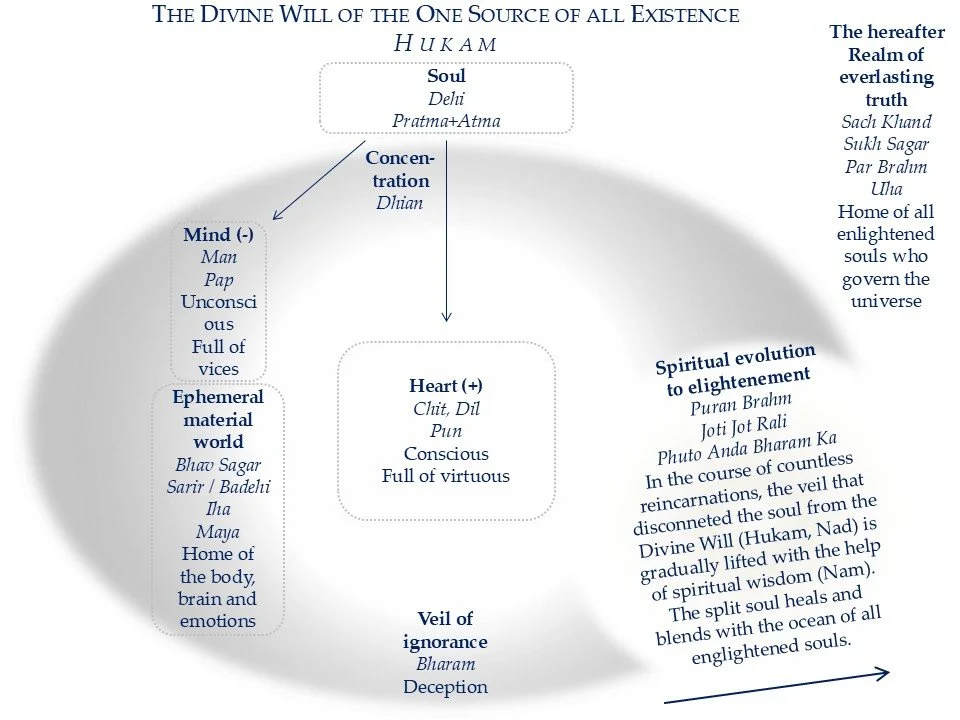
The nature of the soul (Atma).
Credits: Khushwant Singh
Like the sun, the soul (Pratma, Atma) forms the background of life. Its rays give birth to a body with a consciousness. The soul (Dehi) controls the heart and breathing, therefore, they are beyond our control. The body (Sarir) and the brain (Tirkuti) are instruments that are freshly provided after each reincarnation. Metaphorically speaking, the soul is split (Dal). It is like a medal, with two sides that work antagonistically. The wordly unconscious outer part of the soul, the mind (Man), is prone to identify with all ephemeral phenomena (Maya), including the biological body (Badehi), thoughts, desires, emotions, as well as material objects. It is the power of the mind that creates worldly ‘progress’, but also all evil attitudes. Whenever our attention (Dhian) is outside, our brain is working; therefore, thinking eludes energy. On the collective level, capitalism emerges from our mind as it provides the best framework to entertain the insatiable desires of it.[30]
The inner and pure part of the soul – also called heart (Dil, Chit), home (Nij Ghar), temple (Gurduara) – is in tune with the truth (Gur Ka Bhana), and therefore is consciousness about our spiritual origins. The heart is the source of all virtues and realisation, and provides energy through its ability to understanding. The intellect (Aqal, Bhudi) is the force that processes all experiences and sensory impressions. The more insight about its spiritual origin a soul gains, the stronger its light. The more light, the more subtleties of existence are understood. A fully illuminated intellect (Bibek Bhudi) makes the mind vanish. It only uses the brain where it is necessary to function in the material world; otherwise, it keeps focused on the inner centre. It is important to understand in this context that the realm of truth and ephemerality both exist in the here and now. Time is an illusion.[31]
When the wave dies in the ocean
Returning home is difficult. Because the mind – a product of the original conceit – is as easy to seduce by transience as a little wave is carried away by the wind. Once the wave rises, there is turmoil. As soon as the wind vanishes, the wave dies and becomes a part of the serene ocean again. However, a drop that has been blown away from the ocean, cannot reach peace as easily again. At some stage, it cannot even hear the sound of the ocean. Similarly, we come to the conviction that we are soulless, biological machines, when the mind is working at full force. Out of this, a material oriented life style arises, where we are hardly able to deconstruct our identification with the body, objects, mind-made ideologies, identities, beliefs or fictional categories with real impacts such as nation states. Since each of us influences and is being influenced by the existing structures, an over whelming mind-oriented conditioning increases over time. When we become mind-oriented (Manmukh, Mayadhari) and eventually succumb to the mind (Apna Bhana), we are not only ready in our thoughts to harm others, but use our intellect to plan and commit terrible deeds without regret – even in the name of religion. This stage of ignorance leads to an on-going entanglement in the cycle of birth and death.[32]
The Five Thieves - Transforming negative energies to positive
In order to reach peace from the mind, and heal, a prerequisite is addressing the offspring of the original deceit, called the five thieves (Panch Chor/Dhut). They consume positive energies, and are inherent to the mind. Therefore, they need to be subdued and transformed through the food of spiritual wisdom (Brahm Gian, Langar): desire (Kam) into a sense for natural necessities, anger (Krodh) into righteousness, greed (Lobh) into a sense of well-being for everyone, emotional attachment (Moh) into unconditional and subject-independent love, and selfishness (Ahankar) into selflessness. Based on our past, the force of the five thieves vary. Accordingly, our healing process is individual.[33]
The separating poison of hubris itself contains the antidote
Through each of countless reincarnations, we get the possibility to overcome our blemish. The Enlightener therefore helps us to climb the ladder of spiritual evolution (Vigas) step after step, and finally reach the last stage as a human being. Here, we get the possibility of complete healing (Sabat Surat, Ik Man Ik Chit) through enlightenment (Param Gati).[34] It is reached after all worldly desires, including to be born again, have vanished and we are attuned to the Divine Will (Gurmukh). Then we wake up from our current dream state (Phalke Uth). The veil of ignorance is lifted and the egg of illusion dissolves (Phuto Anda Bharam Ka). The wave (Joti) and ocean (Jot) become one. A completely healed soul (Puran Brahm) is ready to return home from the diaspora it has intermittently regarded as its home. Through self-fertilisation by spiritual wisdom, it is born back into the ocean of bliss. But as a human being, we have to be especially cautious since there is a high danger of being trapped by the meanwhile very powerful mind and having to begin all over again.[35]
The mystery behind all this is that the separating poison of hubris itself contains the antidote. In this sense, the cosmic theatre is primarily not about redemption from suffering (Mukti) or a state of emptiness. Rather, the highest art lies in humbly realising the limits of our power, reminding ourselves of the constant need for wisdom through an intimate and harmonious bonding with the One.[36]
The only lasting gift we can give ourselves, is enlightenment
We are like a lantern whose light is pure. Yet, without regular cleansing, our lamp will collect soot on the inside. All efforts to clean it from the outside are in vein. Similarly, efforts with the body, on a technical or structural level, can never clean the root cause of inner pollution. The enlightened ones have demonstrated that the miracle of inner self-cleaning and realisation of the Divine Will is possible. They knew the greatest mystery in life: The only lasting gift we can give ourselves is enlightenment.[37]
Being a guest on this planet
Once we start considering the beauty and profoundness of spiritual wisdom, our planet will flourish. For this, the most important step is a shift in education. The more we teach about the necessity of considering cyclic thinking, which includes giving back to Mother Earth, what we have taken, the more our futures generation will consider alternative economic models – like Gross National Happiness, which measures development based on the satisfaction of citizens and the environment. Our current crisis shows that it is not enough to teach how to become successful professionals within a capitalist society. We need to nourish virtues and explain the implications of being guests on this planet, and the nature of the soul from early age on. We need to create space for open and reflected dialogues with spiritually wise people, and disseminate well-founded and independent publications (instead of interest-led articles or top listed websites and Wikipedia entries on Google). For this, we neither need institutions nor major financial investments.[38]
When spiritual insights become more popular, it will also be easier to assess which are of especial importance to solve specific problems of humankind. Ultimately, the wisdom of spirituality is an offer. It can be integrated in every (secular) sphere of life, whether politics, economy, medicine or psychotherapy. When we apply it on a larger scale, we will be able to strengthen inner and outer peace, and promote sustainable develop without side effects – and leave a memorable legacy for our heirs, on this beautiful blue planet.
Valuing the aesthetics of simplicity and naturalness, and transcending the human-made, leads to peace from mind. To be pure in the midst of impurity (Jivan Mukat), and to love in the midst of hatred – this is art of Gurmat.
The beauty of truth
Egoism and superficiality are like weeds.
They spread with the speed of the wind.
The truth stands.
Quiet.
Lonely.
Shines in the middle of the mud.
Like a lotus.[39]
References
[1] All insights in this essay are derived from Gurbani, the key scriptures of the Sikh Religion. AGGS refers the (Adi) Guru Granth Sahib. The number indicates the page of the standard edition, then the name of the writer follows, like Kabir. M. 1/2 etc. refers to the specific author within the line of the 10 enlightened once. DG refers to the writings of Gur Gobind Singh in the Dasam Granth, which is of special importance for baptised Sikhs. The number indicates the page of the standard edition. Original key terms from Gurbani are added in italics in parenthesis.
[2] ਬੁਧਿ ਵਿਸਰਜੀ ਗਈ ਸਿਆਣਪ ਕਰਿ ਅਵਗਣ ਪਛੁਤਾਇ ॥ AGGS: 76, M. 1; ਜੈਸਾ ਬੀਜੇ ਸੋ ਲੁਣੈ ਜੇਹਾ ਪੁਰਬਿ ਕਿਨੈ ਬੋਇਆ ॥ AGGS: 309, M. 4.
[3] ਕਬੀਰ ਮਨੁ ਜਾਨੈ ਸਭ ਬਾਤ ਜਾਨਤ ਹੀ ਅਉਗਨੁ ਕਰੈ ॥ AGGS: 1376, Kabir; ਪਾਪੁ ਬੁਰਾ ਪਾਪੀ ਕਉ ਪਿਆਰਾ ॥ AGGS: 935, M. 1.
[4] ਝਝਾ ਉਰਝਿ ਸੁਰਝਿ ਨਹੀ ਜਾਨਾ ॥ AGGS: 341, Kabir.
[5] ਨਾਨਕ ਦੁਨੀਆ ਕੀਆਂ ਵਡਿਆਈਆਂ ਅਗੀ ਸੇਤੀ ਜਾਲਿ ॥ AGGS: 1290, Kabir; ਜਉ ਤਉ ਪ੍ਰੇਮ ਖੇਲਣ ਕਾ ਚਾਉ ॥ ਸਿਰੁ ਧਰਿ ਤਲੀ ਗਲੀ ਮੇਰੀ ਆਉ ॥ AGGS: 1412, M. 1; ਤੇਰੋ ਜਨੁ ਹੋਇ ਸੋਇ ਕਤ ਡੋਲੈ ਤੀਨਿ ਭਵਨ ਪਰ ਛਾਜਾ ॥ AGGS: 856, Kabir; ਜਾਣਹੁ ਜੋਤਿ ਨ ਪੂਛਹੁ ਜਾਤੀ ਆਗੈ ਜਾਤਿ ਨ ਹੇ ॥ AGGS: 349, M. 1.
[6] ਕਹੁ ਕਬੀਰ ਜਨ ਭਏ ਖਾਲਸੇ ਪ੍ਰੇਮ ਭਗਤਿ ਜਿਹ ਜਾਨੀ॥ AGGS: 655, Kabir.
[7] ਬੋਲਾਇਆ ਬੋਲੀ ਖਸਮ ਦਾ ॥ AGGS: 74, M. 5; ਗੁਰਮਤਿ ਜਿਨੀ ਪਛਾਣਿਆ ਸੇ ਦੇਖਹਿ ਸਦਾ ਹਦੂਰਿ ॥ AGGS: 27, M. 3; ਸਿਖ ਮਤਿ ਸਭ ਬੁਧਿ ਤੁਮ੍ਹਾਰੀ ਮੰਦਿਰ ਛਾਵਾ ਤੇਰੇ ॥ AGGS: 795, M. 1.
[8] ਗੁਰੁ ਕੁੰਜੀ ਪਾਹੂ ਨਿਵਲੁ ਮਨੁ ਕੋਠਾ ਤਨੁ ਛਤਿ ॥ AGGS: 1237, M. 5; ਪੋਥੀ ਪਰਮੇਸਰ ਕਾ ਥਾਨੁ ॥ AGGS: 1226, M. 5; ਗੁਰਬਾਣੀ ਹਰਿ ਅਲਖੁ ਲਖਾਇਆ ॥ AGGS: 336, M. 4.
[9] ਹਰਿ ਜੁਗੁ ਜੁਗੁ ਭਗਤ ਉਪਾਇਆ ਪੈਜ ਰਖਦਾ ਆਇਆ ਰਾਮ ਰਾਜੇ ॥ AGGS: 451, M. 4.
[10] ਮੰਦਾ ਮੂਲਿ ਨ ਕੀਚਈ ਦੇ ਲੰਮੀ ਨਦਰਿ ਨਿਹਾਲੀਐ ॥ AGGS: 474, M. 2;
[11] ਗੁਰਮੁਖਿ ਨਾਦੰ ਗੁਰਮੁਖਿ ਵੇਦੰ ਗੁਰਮੁਖਿ ਰਹਿਆ ਸਮਾਈ ॥ AGGS: 2, M. 1; ਬਾਣੀ ਪ੍ਰਭ ਕੀ ਸਭੁ ਕੋ ਬੋਲੈ ॥ AGGS: 294, M. 5; ਅੰਤਰ ਆਤਮੈ ਜੋ ਮਿਲੈ ਮਿਲਿਆ ਕਹੀਐ ਸੋਇ ॥ AGGS: 791, M. 5; ਇਕੁ ਸੰਸਾਰੀ ਇਕੁ ਭੰਡਾਰੀ ਇਕੁ ਲਾਏ ਦੀਬਾਣੁ ॥ AGGS: 7, M. 1.
[12] ਸਾਹਿਬੁ ਮੇਰਾ ਏਕੋ ਹੈ ॥ AGGS: 350, M. 1; ਤੂ ਅਣਮੰਗਿਆ ਦਾਨੁ ਦੇਵਣਾ ਸਭਨਾਹਾ ਜੀਆ॥ AGGS: 585, M. 3; ਨਾਨਕ ਚਿੰਤਾ ਮਤਿ ਕਰਹੁ ਚਿੰਤਾ ਤਿਸ ਹੀ ਹੇਇ ॥ AGGS: 955, M. 5; ਜਾਨ ਕੋ ਦੇਤ ਅਜਾਨ ਕੋ ਦੇਤ ਜਮੀਨ ਕੋ ਦੇਤ ਜਮਾਨ ਕੋ ਦੈ ਹੈ ॥ DG: 75; ਹੁਕਮੈ ਅੰਦਰਿ ਸਭੁ ਕੋ ਬਾਹਰਿ ਹੁਕਮ ਨ ਕੋਇ ॥ AGGS: 1, M. 1; ਸਤਿਗੁਰੁ ਸਭਨਾ ਦਾ ਭਲਾ ਮਨਾਇਦਾ ਤਿਸ ਦਾ ਬੁਰਾ ਕਿਉ ਹੋਇ ॥ AGGS: 302, M. 4; ਵਿਣੁ ਤੁਧੁ ਹੋਰੁ ਜਿ ਮੰਗਣਾ ਸਿਰਿ ਦੁਖਾ ਕੈ ਦੁਖ ॥ AGGS: 958, M. 5; ਅੰਮ੍ਰਿਤੁ ਹਰਿ ਕਾ ਨਾਮੁ ਹੈ ਵਰਸੈ ਕਿਰਪਾ ਧਾਰਿ ॥ AGGS: 1281, M. 3.
[13] ਜਿਨ ਮਨਿ ਹੋਰੁ ਮੁਖਿ ਹੋਰੁ ਸਿ ਕਾਂਢੇ ਕਚਿਆ ॥ AGGS: 488, Shekh Farid; ਅਵਰ ਉਪਦੇਸੈ ਆਪਿ ਨ ਕਰੈ ॥ AGGS: 269, M. 5; ਵੇਦਾ ਮਹਿ ਨਾਮੁ ਉਤਮੁ ਸੋ ਸੁਣਹਿ ਨਾਹੀ ਫਿਰਹਿ ਜਿਉ ਬੇਤਾਲਿਆ ॥ AGGS: 919, M. 3; ਸਾਸਤ ਬੇਦ ਸਿਮ੍ਰਿਤਿ ਸਭਿ ਸੋਧੇ ਸਭ ਏਕਾ ਬਾਤ ਪੁਕਾਰੀ ॥ AGGS, M. 3, 919; ਪੜਿਆ ਅਣਪੜਿਆ ਪਰਮ ਗਤਿ ਪਾਵੈ ॥ AGGS: 197, M. 5.
[14] ਭੂਖੇ ਭਗਤਿ ਨ ਕੀਜੈ ॥ ਯਹ ਮਾਲਾ ਅਪਨੀ ਲੀਜੈ ॥ AGGS: Kabir, 656; ਸਾਚੁ ਕਹੌ ਸੁਨ ਲੇਹੁ ਸਭੈ ਜਿਨ ਪ੍ਰੇਮ ਕੀਓ ਤਿਨ ਹੀ ਪ੍ਰਭੁ ਪਾਇਓ ॥ DG: 14.
[15] ਚਿਟੇ ਜਿਨ ਕੇ ਕਪੜੇ ਮੈਲੇ ਚਿਤ ਕਠੋਰ ਜੀਉ ॥ AGGS: 571, M. 1; ਭਾਵੈ ਲਾਂਬੇ ਕੇਸ ਕਰੁ ਭਾਵੈ ਘਰਰਿ ਮੁਡਾਇ ॥ AGGS: 1365, Kabir; ਮੁਸਲਮਾਣੁ ਕਹਾਵਣੁ ਮੁਸਕਲੁ ਜਾ ਹੋਇ ਤਾ ਮੁਸਲਮਾਣੁ ਕਹਾਵੈ ॥ AGGS: 141, M. 1; ਜੋ ਦਿਲੁ ਸੋਧੈ ਸੋਈ ਹਾਜੀ ॥ AGGS: 1081, M. 5; ਐਸਾ ਜੋਗੀ ਵਡਭਾਗੀ ਭੇਟੈ ਮਾਇਆ ਕੇ ਬੰਧਨ ਕਾਟੈ ॥ AGGS: 208, M. 5; ਧ੍ਰਿਗੁ ਤਿਨਾ ਕਾ ਜੀਵਿਆ ਜਿ ਲਿਖਿ ਲਿਖਿ ਵੇਚਹਿ ਨਾਉ ॥ AGGS: 1245, M. 1; ਜਿਸ ਕੈ ਅੰਤਰਿ ਰਾਜ ਅਭਿਮਾਨੁ ॥ ਸੋ ਨਰਕਪਾਤੀ ਹੋਵਤ ਸੁਆਨੁ ॥ AGGS: 279, M. 5; ਜਨ ਨਾਨਕ ਤਿਸੁ ਬਲਿਹਾਰਣੈ ਜੋ ਆਪਿ ਜਪੈ ਅਵਰਾ ਨਾਮੁ ਜਪਾਏ ॥ AGGS: 140, M. 4; ਜਿਨਾ ਸਾਸਿ ਗਿਰਾਸਿ ਨ ਵਿਸਰੈ ਹਰਿ ਨਾਮਾਂ ਮਨਿ ਮੰਤੁ ॥ ਧੰਨੁ ਸਿ ਸੇਈ ਨਾਨਕਾ ਪੂਰਨੁ ਸੋਈ ਸੰਤੁ ॥ AGGS: 319, M. 5; ਗੁਰ ਕਾ ਸਬਦੁ ਮਨੇ ਸੋ ਸੂਰਾ ॥ AGGS: 1023. M. 1.
[16] ਬੋਲੀਐ ਸਚੁ ਧਰਮੁ ਝੂਠੁ ਨ ਬੋਲੀਐ ॥ AGGS: 488, Shekh Farid; ਸਰਬ ਧਰਮ ਮਹਿ ਸ੍ਰੇਸਟ ਧਰਮੁ ॥ ਹਰਿ ਕੋ ਨਾਮੁ ਜਪਿ ਨਿਰਮਲ ਕਰਮੁ ॥ AGGS: 266, M. 5.
[17] ਨਾ ਹਮ ਹਿੰਦੂ ਨ ਮੁਸਲਮਾਨ ॥ AGGS: 1136, M. 5; ਜਪੁ ਤਪੁ ਸੰਜਮੁ ਧਰਮੁ ਨ ਕਮਾਇਆ ॥ AGGS: 12, M. 1; ਰਾਮ ਰਾਮ ਸਭੁ ਕੋ ਕਹੈ ਕਹਿਐ ਰਾਮੁ ਨ ਹੋਇ ॥ AGGS: 491, M. 3; ਵਰਤ ਨ ਰਹਉ ਨ ਮਹ ਰਮਦਾਨਾ ॥ AGGS: 1136, M. 5; ਮਾਸੁ ਮਾਸੁ ਕਰਿ ਮੂਰਖੁ ਝਗੜੇ ਗਆਿਨੁ ਧਆਿਨੁ ਨਹੀ ਜਾਣੈ ॥ AGGS: 156, M. 1; ਗੁਰ ਗਿਆਨੁ ਪਦਾਰਥੁ ਨਾਮੁ ਹੈ ਹਰਿ ਨਾਮੋ ਦੇਇ ਦ੍ਰਿੜਾਇ ॥ AGGS: 759, M. 4; ਰਾਜੁ ਨ ਚਾਹਉ ਮੁਕਤਿ ਨ ਚਾਹਉ ਮਨਿ ਪ੍ਰੀਤਿ ਚਰਨ ਕਮਲਾਰੇ ॥ AGGS: 534, M. 5; ਭੁਲਣ ਅੰਦਰਿ ਸਭੁ ਕੋ ਅਭੁਲੁ ਗੁਰੂ ਕਰਤਾਰੁ ॥ AGGS: 60, M.1.
[18] ਨਾਨਕ ਦਾਸੁ ਮੁਖ ਤੇ ਜੋ ਬੋਲੈ ਈਹਾ ਊਹਾ ਸਚੁ ਹੋਵੈ ॥ AGGS: 681, M. 5; ਸਚੁ ਪੁਰਾਣਾ ਹੋਵੈ ਨਾਹੀ ਸੀਤਾ ਕਦੇ ਨ ਪਾਟੈ ॥ AGGS: 956, M. 1; ਗੁਰਿ ਕਹਿਆ ਸਾ ਕਾਰ ਕਮਾਵਹੁ ॥ ਗੁਰ ਕੀ ਕਰਣੀ ਕਾਹੇ ਧਾਵਹੁ ॥ AGGS: 933, M. 1; ਏ ਅਖਰ ਖਿਰਿ ਜਾਹਿਗੇ ਓਇ ਅਖਰ ਇਨ ਮਹਿ ਨਾਹਿ ॥ Kabir: 340; ਲੋਗੁ ਜਾਨੈ ਇਹੁ ਗੀਤੁ ਹੈ ਇਹੁ ਤਉ ਬ੍ਰਹਮ ਬੀਚਾਰ ॥ AGGS: 335, Kabir; ਊਤਮ ਕਰਣੀ ਸਬਦ ਬੀਚਾਰ॥ AGGS: 158, M. 3; ਦਾਤਿ ਪਿਆਰੀ ਵਿਸਰਿਆ ਦਾਤਾਰਾ ॥ AGGS: 676, M. 5; ਬੂਝੈ ਬੂਝਨਹਾਰੁ ਬਿਬੇਕ ॥ AGGS: 285, M. 5; ਹਰਿ ਜਨੁ ਐਸਾ ਚਾਹੀਐ ਜੈਸਾ ਹਰਿ ਹੀ ਹੋਇ ॥ AGGS: 1372, Kabir.
[19] ਆਪਨੜੇ ਗਿਰੀਵਾਨ ਮਹਿ ਸਿਰੁ ਨੀਂਵਾਂ ਕਰਿ ਦੇਖੁ ॥ AGGS: 1378, Shekh Farid; ਬੰਦੇ ਖੋਜੁ ਦਿਲ ਹਰ ਰੋਜ ਨਾ ਫਿਰੁ ਪਰੇਸਾਨੀ ਮਾਹਿ ॥ AGGS: 727, Kabir.
[20] ਮਨਿ ਮੈਲੈ ਸਭੁ ਕਿਛੁ ਮੈਲਾ ਤਨਿ ਧੋਤੈ ਮਨੁ ਹਛਾ ਨ ਹੋਇ ॥ AGGS: 558, M. 3; ਫਰੀਦਾ ਜੇ ਤੂ ਅਕਲਿ ਲਤੀਫੁ ਕਾਲੇ ਲਿਖੁ ਨ ਲੇਖ ॥ AGGS: 1378, Shekh Farid.
[21] The relationship between good and evil is discussed in many traditions, like Yang and Yin in Daoism, or Jetzer ha-Tov and Jetzer ha-Ra in Judaism.
[22] ਕਾਇਆ ਅੰਦਰਿ ਪਾਪੁ ਪੁੰਨੁ ਦੁਇ ਭਾਈ ॥ ਦੁਹੀ ਮਿਲਿ ਕੈ ਸ੍ਰਿਸਟਿ ਉਪਾਈ ॥ AGGS: 26, M. 3; ਤ੍ਰਿਸਨਾ ਬੁਝੈ ਹਰਿ ਕੈ ਨਾਮਿ ॥ AGGS: 682, M. 5.
[23] ਹਕੁ ਹਲਾਲੁ ਬਖੋਰਹੁ ਖਾਣਾ ॥ AGGS: 1084, M. 5; ਗੁਰਮੁਖਿ ਖੋਟੇ ਖਰੇ ਪਛਾਣੁ ॥ AGGS: 942, M. 1; ਇਹੁ ਸਰੀਰੁ ਸਭੁ ਧਰਮੁ ਹੈ ਜਿਸੁ ਅੰਦਰਿ ਸਚੇ ਕੀ ਵਿਚਿ ਜੋਤਿ ॥ AGGS: 309, M. 4; ਗਿਆਨ ਖੜਗ ਪੰਚ ਦੂਤ ਸੰਘਾਰੇ ਗੁਰਮਤਿ ਜਾਗੈ ਸੋਇ ॥ AGGS: 1414, M. 3; ਕਬੀਰ ਸੇਵਾ ਕਉ ਦੁਇ ਭਲੇ ਏਕੁ ਸੰਤੁ ਇਕੁ ਰਾਮੁ ॥ AGGS: 1373, Kabir; ਸੂਰਾ ਸੋ ਪਹਿਚਾਨੀਐ ਜੁ ਲਰੈ ਦੀਨ ਕੇ ਹੇਤ ॥ AGGS: 1105, Kabir; ਅਵਰ ਬਾਸਨਾ ਨਾਹਿ ਪ੍ਰਭ ਧਰਮ ਜੁੱਧ ਕੇ ਚਾਇ ॥ DG: 1133.
[24] ਜਬ ਕਛੁ ਨ ਸੀਓ ਤਬ ਕਿਆ ਕਰਤਾ ਕਵਨ ਕਰਮ ਕਰਿ ਆਇਆ ॥ AGGS: 748, M. 5.
[25] ਸਚ ਖੰਡਿ ਵਸੈ ਨਿਰੰਕਾਰੁ ॥ AGGS: 8, M. 1; ਤੈਸੇ ਬਿਸ੍ਵ ਰੂਪ ਤੇ ਅਭੂਤ ਭੂਤ ਪ੍ਰਗਟ ਹੋਇ ਤਾਹੀ ਤੇ ਉਪਜਿ ਸਬੈ ਤਾਹੀ ਮੈ ਸਮਾਹਿਾਂਗੇ ॥ ਅਨੇਕ ਹੈਂ ਫਿਰ ਇਕ ਹੈਂ ॥ DG: 8; ਸਾਗਰ ਮਹਿ ਬੂੰਦ ਬੂੰਦ ਮਹਿ ਸਾਗਰੁ ਕਵਣੁ ਬੁਝੈ ਬਿਧਿ ਜਾਣੈ ॥ AGGS: 878, M. 1.
[26] ਸੁੰਨ ਸਮਾਧਿ ਅਨਹਤ ਤਹ ਨਾਦ ॥ 292 M. 5; ਕਈ ਬਾਰ ਪਸਰਿਓ ਪਾਸਾਰ ॥ ਸਦਾ ਸਦਾ ਇਕੁ ਏਕੰਕਾਰ ॥ AGGS: 276, M. 5; ਸਾਚੇ ਤੇ ਪਵਨਾ ਭਇਆ ਪਵਨੈ ਤੇ ਜਲੁ ਹੋਇ ॥ AGGS: 19, M. 1.
[27] ਭਰਮੇ ਭੂਲੇ ਆਵਉ ਜਾਉ॥ AGGS: 229, M. 3; ਭਰਮੇ ਭੂਲਾ ਦਹ ਦਿਸਿ ਧਾਵੈ॥ AGGS: 277, M. 5; ਜੰਮਣੁ ਮਰਣਾ ਹੁਕਮੁ ਹੈ ਭਾਣੈ ਆਵੈ ਜਾਇ ॥ AGGS: 472, M. 1; ਹਉ ਆਇਆ ਦੂਰਹੁ ਚਲਿ ਕੈ ਮੈ ਤਕੀ ਤਉ ਸਰਣਾਇ ਜੀਉ ॥ AGGS: 763 M. 5.
[28] ਜੋ ਜੋ ਦੀਸੈ ਸੋ ਸੋ ਰੋਗੀ ॥ ਰੋਗ ਰਹਿਤ ਮੇਰਾ ਸਤਿਗੁਰੁ ਜੋਗੀ ॥ AGGS: 1140 M. 5; ਸੰਸਾਰੁ ਰੋਗੀ ਨਾਮੁ ਦਾਰੂ ਮੈਲੁ ਲਾਗੈ ਸਚ ਬਿਨਾ ॥ AGGS: 678, M. 1; ਹਮ ਅਵਗੁਣਿ ਭਰੇ ਏਕੁ ਗੁਣੁ ਨਾਹੀ ਅੰਮ੍ਰਿਤੁ ਛਾਡਿ ਬਿਖੈ ਬਿਖੁ ਖਾਈ ॥ AGGS: 1406, Bal; ਆਪੁ ਆਪੁਨੀ ਬੁਧਿ ਹੈ ਜੇਤੀ ॥ ਬਰਨਤ ਭਿੰਨ ਭਿੰਨ ਤੁਹਿ ਤੇਤੀ ॥ DG: 2746; ਝਗੜਾ ਕਰਦਿਆ ਅਨਦਿਨੁ ਗੁਦਰੈ ਸਬਦਿ ਨ ਕਰੈ ਵੀਚਾਰੁ ॥ AGGS: 549, M. 3.
[29] ਖੰਨਿਅਹੁ ਤਿਖੀ ਵਾਲਹੁ ਨਿਕੀ ਏਤੁ ਮਾਰਗਿ ਜਾਣਾ ॥ AGGS: 918, M. 3
[30] ਬੀਉ ਬੀਜਿ ਪਤਿ ਲੈ ਗਏ ਅਬ ਕਿਉ ਉਗਵੈ ਦਾਲਿ ॥ AGGS: 468, M. 1; ਮਨ ਤੂੰ ਜੋਤਿ ਸਰੂਪੁ ਹੈ ਆਪਣਾ ਮੂਲੁ ਪਛਾਣੁ ॥ AGGS: 441; M. 3.
[31] ਦੇਹੀ ਗੁਪਤ ਬਿਦੇਹੀ ਦੀਸੈ ॥ AGGS: 900, M. 5; ਇਹ ਬਾਣੀ ਮਹਾ ਪੁਰਖ ਕੀ ਨਿਜ ਘਰਿ ਵਾਸਾ ਹੋਇ ॥ AGGS: 935, M. 1: ਗੁਰਦੁਆਰੈ ਲਾਇ ਭਾਵਨੀ ਇਕਨਾ ਦਸਵਾ ਦੁਆਰੁ ਦਿਖਾਇਆ ॥ AGGS: 922, M. 3; ਬੂਝੈ ਦੇਖੈ ਕਰੈ ਬਿਬੇਕ ॥ AGGS: 279, M. 5; ਹਾਥ ਪਾਉ ਕਰਿ ਕਾਮੁ ਸਭੁ ਚੀਤੁ ਨਿਰੰਜਨ ਨਾਲਿ ॥ AGGS: 1376, Kabir; ਭਵ ਸਾਗਰ ਸੁਖ ਸਾਗਰ ਮਾਹੀ ॥ AGGS: 323, Kabir.
[32] ਆਪਣੈ ਭਾਣੈ ਜੋ ਚਲੈ ਭਾਈ ਵਿਛੁੜਿ ਚੋਟਾ ਖਾਵੈ ॥ AGGS: 601, M. 3; ਮਾਇਆਧਾਰੀ ਅਤਿ ਅੰਨਾ ਬੋਲਾ ॥ ਸਬਦੁ ਨ ਸੁਣਈ ਬਹੁ ਰੋਲ ਘਚੋਲਾ ॥ AGGS: 313, M. 3; ਲਖ ਚਉਰਾਸੀਹ ਭਰਮਦੇ ਭ੍ਰਮਿ ਭ੍ਰਮਿ ਹੋਇ ਖੁਆਰੁ ॥ AGGS: 27, M. 3; ਮਨਮੁਖਾ ਨੋ ਫਿਰਿ ਜਨਮੁ ਹੈ ਨਾਨਕ ਹਰਿ ਭਾਏ ॥ AGGS: 450, M. 4.
[33] ਇਸੁ ਦੇਹੀ ਅੰਦਰਿ ਪੰਚ ਚੋਰ ਵਸਹਿ ਕਾਮੁ ਕ੍ਰੋਧੁ ਲੋਭੁ ਮੋਹੁ ਅਹੰਕਾਰਾ ॥ AGGS: 600, M. 3; ਬ੍ਰਹਮ ਗਿਆਨੀ ਕਾ ਭੋਜਨੁ ਗਿਆਨ ॥ AGGS: 273, M. 5; ਲੰਗਰੁ ਚਲੈ ਗੁਰ ਸਬਦਿ ਹਰਿ ਤੋਟਿ ਨ ਆਵੀ ਖਟੀਐ ॥ AGGS: 967, Balvand Te Sata.
[34] ਲਖ ਚਉਰਾਸੀਹ ਜੋਨਿ ਸਬਾਈ ॥ ਮਾਣਸ ਕਉ ਪ੍ਰਭਿ ਦੀਈ ਵਡਿਆਈ ॥ AGGS: 1075, M. 5; ਨਾਨਕ ਭਗਤਾ ਸਦਾ ਵਿਗਾਸੁ ॥ AGGS: 2, M. 1; ਹਉ ਆਇਆ ਦੂਰਹੁ ਚਲਿ ਕੈ ਮੈ ਤਕੀ ਤਉ ਸਰਣਾਇ ਜੀਉ ॥ AGGS: 763, M. 5; ਨਾਪਾਕ ਪਾਕੁ ਕਰਿ ਹਦੂਰਿ ਹਦੀਸਾ ਸਾਬਤ ਸੂਰਤਿ ਦਸਤਾਰ ਸਿਰਾ ॥ AGGS: 1084, M. 5; ਜਿਨਾ ਇਕ ਮਨਿ ਇਕ ਚਿਤਿ ਧਿਆਇਆ ਸਤਿਗੁਰ ਸਉ ਚਿਤੁ ਲਾਇ ॥ AGGS: 1423, M. 3; ਅੰਮ੍ਰਿਤ ਬਾਣੀ ਹਰਿ ਹਰਿ ਤੇਰੀ ॥ ਸੁਣਿ ਸੁਣਿ ਹੋਵੈ ਪਰਮ ਗਤਿ ਮੇਰੀ ॥ AGGS: 103, M. 5.
[35] ਗੁਰਮੁਖਿ ਮਨੁ ਸਮਝਾਈਐ ਆਤਮ ਰਾਮੁ ਬੀਚਾਰਿ ॥ AGGS: 18, M. 1; ਜੈਸਾ ਸੁਪਨਾ ਰੈਨਿ ਕਾ ਤੈਸਾ ਸੰਸਾਰ ॥ AGGS: 808, M. 5; ਤੈ ਜੀਵਨੁ ਜਗਿ ਸਚੁ ਕਰਿ ਜਾਨਾ ॥ AGGS: 794, Ravidas; ਗੁਰ ਸਤਿਗੁਰ ਕਾ ਜੋ ਸਿਖੁ ਅਖਾਏ ਸੁ ਭਲਕੇ ਉਠਿ ਹਰਿ ਨਾਮੁ ਧਿਆਵੈ ॥ AGGS: 305, M. 4; ਫੂਟੋ ਆਂਡਾ ਭਰਮ ਕਾ ਮਨਹਿ ਭਇਓ ਪਰਗਾਸੁ ॥ AGGS: 1002, M. 5; ਜੋਤੀ ਜੋਤਿ ਰਲੀ ਸੰਪੂਰਨੁ ਥੀਆ ਰਾਮ ॥ AGGS: 846, M. 5; ਛੋਡਿ ਪਰਦੇਸਹਿ ਧਾਇਆ॥ AGGS: 1348, M. 5; ਪੂਰਨ ਬ੍ਰਹਮੁ ਰਵਿਆ ਮਨ ਤਨ ਮਹਿ ਆਨ ਨ ਦ੍ਰਿਸਟੀ ਆਵੈ ॥ AGGS: 531, M. 5; ਜੇ ਇਕੁ ਹੋਇ ਤ ਉਗਵੈ ਰੁਤੀ ਹੂ ਰੁਤਿ ਹੋਇ ॥ AGGS: 468, M. 1; ਇਸੁ ਪਉੜੀ ਤੇ ਜੋ ਨਰੁ ਚੂਕੈ ਸੋ ਆਇ ਜਾਇ ਦੁਖੁ ਪਾਇਦਾ ॥ AGGS: 1075, M. 5.
[36] ਹਉਮੈ ਦੀਰਘ ਰੋਗੁ ਹੈ ਦਾਰੂ ਭੀ ਇਸੁ ਮਾਹਿ ॥ AGGS: 466, M. 2; ਦੁਖੁ ਦਾਰੂ ਸੁਖੁ ਰੋਗੁ ਭਇਆ ਜਾ ਸੁਖੁ ਤਾਮਿ ਨ ਹੋਈ ॥ AGGS: 469, M. 1; ਰਾਜੁ ਨ ਚਾਹਉ ਮੁਕਤਿ ਨ ਚਾਹਉ ਮਨਿ ਪ੍ਰੀਤਿ ਚਰਨ ਕਮਲਾਰੇ ॥ AGGS: 534, M. 5; ਮੁਕਤਿ ਬਪੁੜੀ ਭੀ ਗਿਆਨੀ ਤਿਆਗੇ ॥ AGGS: 1078, M. 5.
[37]ਬਾਹਰਿ ਢੂਢਤ ਬਹੁਤੁ ਦੁਖੁ ਪਾਵਹਿ ਘਰਿ ਅੰਮ੍ਰਿਤੁ ਘਟ ਮਾਹੀ ਜੀਉ ॥ AGGS: 598; M. 1; ਸਚੁ ਤਾਂ ਪਰੁ ਜਾਣੀਐ ਜਾ ਆਤਮ ਤੀਰਥਿ ਕਰੇ ਨਿਵਾਸੁ ॥ AGGS: 468, M. 1; ਹੈਨਿ ਵਿਰਲੇ ਨਾਹੀ ਘਣੇ ਫੈਲ ਫਕੜੁ ਸੰਸਾਰੁ ॥ AGGS: 1411, M. 1; ਏਹ ਕਿਨੇਹੀ ਦਾਤਿ ਆਪਸ ਤੇ ਜੋ ਪਾਈਐ ॥ AGGS: 474, M. 5; ਆਪਣ ਹਥੀ ਆਪਣਾ ਆਪੇ ਹੀ ਕਾਜੁ ਸਵਾਰੀਐ ॥ AGGS: 474, M. 1.
[38] ਹੋਇ ਪੈ ਖਾਕ ਫਕੀਰ ਮੁਸਾਫਰੁ ਇਹੁ ਦਰਵੇਸੁ ਕਬੂਲੁ ਦਰਾ ॥ AGGS: 1083, M. 5; ਹੋਇ ਇਕਤ੍ਰ ਮਿਲਹੁ ਮੇਰੇ ਭਾਈ ਦੁਬਿਧਾ ਦੂਰਿ ਕਰਹੁ ਲਿਵ ਲਾਇ ॥ AGGS: 1185, M. 5.
[39] ਜੋ ਹਰਿ ਲੋੜੇ ਸੋ ਕਰੇ ਸੋਈ ਜੀਅ ਕਰੰਨਿ ॥ AGGS: 134, M. 5; ਰੁਖੀ ਸੁਖੀ ਖਾਇ ਕੈ ਠੰਢਾ ਪਾਣੀ ਪੀਉ ॥ ਫਰੀਦਾ ਦੇਖਿ ਪਰਾਈ ਚੋਪੜੀ ਨਾ ਤਰਸਾਏ ਜੀਉ ॥ AGGS: 1379, Shekh Farid; ਜੀਵਨ ਮੁਕਤਿ ਸੋ ਆਖੀਐ ਮਰਿ ਜੀਵੈ ਮਰੀਆ ॥ AGGS: 449, M. 4; ਆਈ ਪੰਥੀ ਸਗਲ ਜਮਾਤੀ ਮਨਿ ਜੀਤੈ ਜਗੁ ਜੀਤੁ ॥ AGGS: 6, M. 1; ਅਲਿਪਤੁ ਰਹਉ ਜੈਸੇ ਜਲ ਮਹਿ ਕਉਲਾ ॥ AGGS: 384, M. 5; ਕਬੀਰ ਜਿਹ ਮਾਰਗਿ ਪੰਡਿਤ ਗਏ ਪਾਛੈ ਪਰੀ ਬਹੀਰ ॥ ਇਕ ਅਵਘਟ ਘਾਟੀ ਰਾਮ ਕੀ ਤਿਹ ਚੜਿ ਰਹਿਓ ਕਬੀਰ ॥ AGGS: 1373, Kabir.
Source
Singh, Khushwant. (2018). Gurmat – The Art of Spiritual Wisdom. How Peace from Mind through Knowledge of the Soul can Help Overcoming the Challenges of Humankind. In James Walters (Ed.), Religious Imaginations (pp. 218-233). Gingko Press.