Basics of Sikhi: Living with Wisdom (Gurmat)

Self-knowledge, lived wisdom, joie de vivre, righteousness, closeness to nature and dedication to the common good are at the heart of the Sikhi. Credits: Pexels
Introduction into Sikhi
Living with wisdom: Virtues
The Sikh religion (also known as Sikhism) is originally called Sikhi, Gurmat, and Sikh Mat. It is one of the youngest world religions. At the center of Sikhi is unifying yet pluralistic timeless wisdom that has been revealed to over 30 Enlightened Ones (Gur, Bhagat). The original insights of these Wise Ones, who descended from different socio-cultural backgrounds, have been passed down in the script-language Gurmukhi. Timeless spiritual wisdom preserved in written form is called Gurbani. Internalizing this wisdom and bringing it to life is utmost important for Sikhs.
At the core of Sikhi is love, lifelong learning, and being in tune with the Divine Will (Hukam) through spiritual wisdom (Nam). Sikhs consciously strive to live a healthy, sincere, dignified, humble, welfare-oriented, creative, and fearless life, deeply respecting nature with a cyclical worldview.
Sikhs focus on self-exploration and the impact of their thoughts and actions. This involves being guided by wisdom in everyday life and transcending the ego. Sikhs surrender to divine grace (Gurparsad) in oder to transcend the diaspora of ephemerality, end the cycle of birth and death, reach enlightenment, and return to the original spiritual homeland of all enlightened souls (Allah, Hari, Kartar, Khudae, Parmesar, Par Brahm, Ram, Sach Khand, Sukh Sagar, Wahe Guru).
Dogmatic and dualistic views, a creed, the worship of an externalized God, ritualized practices, pilgrimages, fasting, celibacy, indulgences, monasticism, superstition, esotericism, and specific meditation or yoga techniques are alien to Gurmat.
Unity in plurality: Multi-voiced unison
The insights of the Enlightened Ones have been handed down in the foundational work known as the (Adi) Guru Granth Sahib (GGS). This 1430-page collection of the original writings (Gurbani) is considered by Sikhs as the highest source of spiritual inspiration and serves as an ethical compass. The influential Wise One Gur Nanak, the first of the lineage of ten direct Enlightened Ones (Gur), was born in Nankana Sahib in 1469. He initiated the collection of the revealed insights. He consciously included the insights of numerous other Wise Ones like Bhagat Kabir and several Bhatt.
The tenth Enlightened One Gur Gobind Singh was born in 1666. In 1708 he completed the canonization which had been significantly advanced by Gur Arjan. The final oeuvre, the result of a unique collaboration of over 200 years, is commonly known as (Adi) Guru Granth Sahib. Thus, Gur Gobind Singh ensured that the insights revealed to the Wise Ones could be preserved and passed on from generation to generation.
The writings of Gur Gobind Singh are included in the oeuvre known today as Dasam Granth. They are central to the communal recitations and initiation (Khande Di Pahul) of a role-model Sikh into the order of the Khalsa, the pure ones. Sikhs of this order can be recognized by uniform characteristics, the Five Kakar.
Today, Sikhs offer increasingly decentralized services and organize podcasts and (online-)workshops for the younger generations to pass on the timeless wisdom which has been passed on to them.
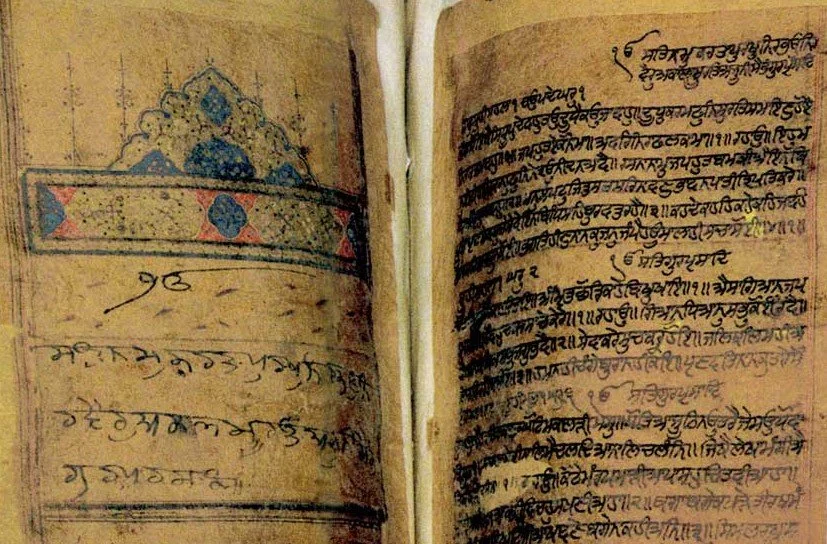
An old handwritten original manuscript with the revelations of over 30 Enlightened Ones who are at the heart of the Sikhi. Credits: Wikipedia
World wide presence: Optimism
The spiritual and ethical oriented Sikh way of life developed between the 15th and 17th centuries in northern India. Despite repeated oppression and persecution throughout history, Sikhs have been able to preserve Sikhi’s wisdom and traditions through devotion, trust and optimism.
Approximately 25 million people worldwide affiliate with Sikhi. Its followers are called Sikhs, disciples of wisdom. The majority of Sikhs are based in the Panjab region of northern India, where they originated. Nevertheless, Sikhs today live well integrated in all parts of the world. Diligence, joie de vivre, and resilience have helped Sikhs establish communities on all continents despite ongoing experiences of discrimination. Increasingly, Sikhs can be found in leadership positions. In Germany, Austria and Switzerland, Sikhs have settled especially since the 1980s. A total of around 35,000 Sikhs live in the German speaking regions.
In recent years Sikhs have become more intentional in examining the layered impacts of colonial experiences, which have led to a multifaceted estrangement from this wisdom-oriented way of life. As part of this process, literal or worldly interpretations and translations of the original wisdom, along with institutions, dogmas, concepts, rituals, and the commercialization of religion — all of which stand in contrast to the essence of Sikhi — are increasingly being questioned and critically reflected upon. In this context, decentralized and virtual spaces for learning and reflection are gaining significance. The transmission of timeless wisdom and its corresponding spiritual way of life for future generations now takes place more and more through podcasts and virtual workshops. Spiritual care, guidance on discrimination, and even career counseling are likewise being organized online.
Dedication to the well-being of all: Dignity
Despite recurring oppression throughout history and experiences of discrimination and violence, Sikhs have not only preserved the wisdom which has been passed down to them. They also stand alongside those in need of help. A tradition that has evolved from Sikhi’s public welfare orientation is Langar. It is a reminder that the soul needs spiritual wisdom, the body pure food, and the needy once support, regardless of their background. Sikhs provide free meals in their communities to all visitors, especially those in need, such as the homeless people and refugees. This service puts across the message that all people deserve equal dignity, regardless of their background or economic condition. Sikhs also support victims of famine and other disasters by providing free food, necessary goods (such as oxygen tanks and masks in the Corona pandemic), and spiritual care.
Worldwide, Sikhs are active in interfaith dialogue, peace and education work. They engage in environmental protection activities and in initiatives against racism. They oppose injustice, discrimination of minorities, racism and other forms of fanaticism, abuse of power and exploitation of religion for political and business purposes. This attitude is symbolized above all by the community of the pure ones called Khalsa.
Unique traditions: Creativity
Sikhi is a unique way of life with a distinct script-language (Gurmukhi), divine poetry (Gurbani), musical tradition and defensive art (Shastar Vidya, Gatka).
The names of the Sikhs also bear a distinctive feature. As a sign of siblinghood, Sikh women use the surname Kaur (princess) and men the name Singh (lion). Where a common surname is required for legal reasons, Sikhs use an inspirational word from Gurbani, expressing a virtue of character.
Also, the appearance of Sikhs is unique. They keep their hair uncut and cover it. In this way, they express dignity, naturalness, humility and respect. Traditionally, male Sikhs are recognized by their turban (Dastar) and uncut beard. Women usually cover their head with a scarf, some wear a turban. Small Sikh boys use various types of a cloth (Rumal or Patka) to cover the hair tied into a chignon in the middle of the head. The head covering, traditionally in heavenly colors, is tied daily. The topknot covers the sensitive area of the fontanel. The turban provides protection from heat, cold and head injuries.
Role-model Sikhs who are accepted into the Khalsa order are not elected but selected based on their character and wisdom. They are initiated through a ceremony known as Khande Di Pahul and are recognizable by five uniform characteristics, the Panj Kakar:
Uncut and covered hair - symbolizes naturalness, devotion, dignity and virtuous life (Keski, Kes)
Wooden comb - symbolizes purity; it is used to comb the hair daily (Khanga)
Iron bangle - stands for courage; several large bangels together were worn in defensive battles to protect oneself against sword blows and other attacks (Karha)
Cotton shorts - symbolizes strength of character and responsibility; they cover the lower body and allow to move comfortably (Kashaira)
Small sword - symbolizes the grace and power of wisdom to eliminate the bad and preserve the good; swords have been worn for self-defense since the time of Gur Hargobind, after Sikhs have been increasingly persecuted and attacked (Kirpan)