
Khushwant Singh’s essay explores the tension between Chronos as a linear and economized concept of time and Kairos as time experienced in its own right. Singh shows that concepts of time are not neutral, but rather expressions of worldviews, control, and power relations. They are also closely intertwined with notions of life and death. Linear concepts of time, such as the Gregorian calendar, have historically prevailed, replacing cyclical perspectives through colonization and hegemony, among other means. They have not only facilitated the exploitation of human beings, animals, and nature, but are also connected to contemporary developments such as the pursuit of life extension and transhumanism. Drawing on the Sikhi way of life, which developed in Asia beginning in the 15th century CE, this article offers insights into a spiritual and cyclical understanding of time and divine order. The essay thereby opens up a space for reflection on how to understand time beyond linear notions of progress in a capitalist and digitalized world, and how to view death not as an end, but as a transition within cosmic evolution.
Credits: Pixabay
The leaf blossoms.
Falls from the tree.
With dignity.
Becomes part of the earth.
Gives rise to new life.
The paradox of time: Measured time versus subjectively experienced time
Time and death are two sides of the same coin. How we interpret time also influences how we approach death. And how we view death depends on how we live. Drawing on the insights of Sikhi, this essay opens up space for reflection on spiritual perspectives on time and death, connecting these themes with colonial contexts and the challenges facing humanity today. Let us begin with the subject of time.
No clock can capture the feeling of a moment. Behind the facade of 86,400 seconds and 24 hours a day lie many mysteries. We often experience measurable time through two dimensions: linear and measurable time, Chronos, and subjectively experienced time, Kairos.
Physics defines objective time in units based on the oscillations of cesium atoms. We, however, experience time subjectively. It stretches or contracts like living fabric, depending on how we experience an event. Moments of fear seem endless, while hours filled with joy pass in the blink of an eye. During moments of heightened intensity, our brains store more details, making time seem longer in retrospect. When we surrender to routines, by contrast, the brain filters out redundancy, and time appears to shrink when we look back. For children, years often seem to pass more slowly because their brains are constantly processing new stimuli. As they grow older, time seems to speed up because the number of formative experiences decreases and routines become more dominant (Adam, 1990; Wittmann, 2016).
Science is not the only field concerned with the phenomenon of time. Remarkable depictions of it can also be found in popular literature.
Momo, longevity, and the transhumanists
In Michael Ende’s 1973 novel Momo, a young girl resists the gray gentlemen, agents of the Timesaving Bank. They persuade people to save time by giving up dreams, play, art, friendship, and even doing nothing. As a result, people become frantic, cold, and joyless, even though they believe they are becoming more efficient. Their lives begin to resemble a kind of death. Little Momo is the only one who can withstand this. Since she makes no plans for the future and has no worries about the past, she lives in the present moment. She is a master of Kairos and possesses a special gift: she knows how to listen.
The gray gentlemen symbolize Chronos: a linear, economized concept of time in which every second must have a utilitarian value. Master Secundus Minutus Hora and the tortoise Cassiopeia, who come to Momo’s aid, embody concepts of the nature of time. Master Hora symbolizes the nature of cyclical processes. His appearance changes throughout the day, from an old man to a child. Then the process begins all over again. Cassiopeia represents a form of time that eludes measurement. She moves slowly, yet is always in the right place at the right time. She can even see a little into the future. This symbolizes an intuition that does not calculate but simply knows. Her name refers to a constellation, underscoring her connection to the cosmos. With their help, Momo succeeds in finding the headquarters of the time thieves and returning the stolen time to the people in the form of hour-flowers. The image of the hour-flowers transforms time from a mathematical commodity into a living phenomenon. A flower blossoms and withers. Neither it nor its fragrance and beauty can be stored away for later.
Michael Ende anticipated much of what has become reality in many parts of the world today when it comes to our relationship with time. Particularly in industrialized nations, we have more money, conveniences, and leisure time than people in earlier periods, such as during the Industrial Revolution, thanks to numerous technological and medical advances. However, the World Happiness Report 2026 shows that increasing material prosperity does not automatically lead to greater life satisfaction. The report identifies the loss of genuine social connections, declining trust in other people and institutions, and increasing psychological strain as key factors. Notably, countries with high levels of social fragmentation and growing loneliness report lower levels of well-being, even when income and consumption levels are high. Greater social media use among young people correlates with lower life satisfaction and well-being. The report points out that human happiness depends more on stable relationships, trust, and social connectedness than on purely economic prosperity (Helliwell, Layard, Sachs, De Neve, Aknin & Wang, 2026). This is a striking finding, especially since we are actually spending more and more time on self-optimization. Our use of digital technologies plays a role in this development, serving both as a symptom and as an amplifier.
Virtual social platforms and chatbots deliberately exploit our need for attention and self-expression. Through algorithmically curated content, they seek to keep us engaged for as long as possible. They create the impression that an even more satisfying stimulus is waiting behind every next swipe or click. As a result, we invest increasingly more time in digital media, compare ourselves with others through likes and followers, and appear to be permanently connected. Yet existential crises reveal just how fleeting digital networks can be and how limited virtual closeness is as a substitute for human connection (Rushkoff, 2013; Rosa, 2005; Wajcman, 2015; Haidt, 2024).
Longevity and transhumanism represent a new form of self-optimization and the attempt to control time. The aim is not merely to slow down human aging through nutritional optimization and technology. The ultimate goal is to overcome death as a biological necessity. In this biotechnocratic vision, the human body is viewed as hardware in need of repair. Through clinical interventions, genetic optimization, or the uploading of consciousness into digital storage systems, it is supposed to become immortal. Some of the wealthiest people in particular are turning to cryonics: after cardiac arrest, their bodies are stored in liquid nitrogen at approximately -196°C in the hope of being technologically revived in the future. Here, time is regarded as a linear variable that can be controlled through intervention (Ettinger, 1962; More, 2013; Attia & Gifford, 2023).
The attempt to make time controllable began long before modern biotechnology. It is particularly evident in the establishment of those temporal reference points that structure our everyday lives.
The power to define the beginning of the year and the attempt to control time
Why does the New Year actually begin on January 1? On closer examination, our present-day calendar turns out not to be a natural constant, but rather a human-made instrument of power.
Around 2,000 years ago, the year in ancient Rome began in March. New Year's Day was closely associated with spring and the awakening of nature. The fields could be cultivated again. March was also associated with military campaigns. Mars was not only a god of agriculture but also of war. During winter, warfare often came to a halt because of weather conditions. March marked the beginning of the new campaign season. September (Latin septem = seven) was the seventh month, not the ninth as it is today, and December (decem = ten) was the tenth month. An adjustment took place around 153 BCE, when the Roman Senate moved the beginning of the consuls' term of office to January 1. The start of the year thus became increasingly detached from ecological rhythms and was placed at the service of state efficiency. Julius Caesar consolidated this arrangement in the Julian calendar. In an empire stretching from Gaul to Egypt, orders had to be coordinated across vast distances and periods of time. A uniform, linear calendar was useful for this purpose. A defined year of 365 days made it easier to plan bureaucratic and military processes as well as budgets. In 1582, Pope Gregory XIII replaced the Julian calendar with the Gregorian calendar, introducing a more refined leap-year rule. The Gregorian reform perfected the measurement of linear time, which extends from the starting point of the Christian calendar into the future, toward the end of time, or the Last Judgment (Richards, 1998; Borst, 1990; Steel, 2000).
Interestingly, alternative linear calendars do not place their starting point at zero around a religious figure. The Holocene calendar begins its count with the emergence of human civilization. According to this system, we are currently in the year 12,026 Human Era. The concept of Big History places humanity within an epic evolutionary narrative. Accordingly, time begins approximately 13.8 billion years ago with the Big Bang and the formation of our observable universe (Emiliani, 1993; Knoll, 2003; Christian, 2018). Such alternative systems of timekeeping remind us that human beings are not the crown of creation, but living beings within an ancient ecosystem. From this perspective, celebrating a new year can be understood as a gesture of reverence for the magic and resilience of life: a life that has endured meteorite impacts, ice ages, mass extinctions, and continental drift.
Linear hegemony: The colonization of Indigenous concepts of time
A look at colonial history and its many ongoing effects on the end-time concepts of various traditions helps us better understand the political dimensions of power associated with the subject of time.
The term eschatology, originating primarily from Abrahamic perspectives, is largely attributed to the Lutheran theologian Abraham Calov, who lived in the 17th century CE. It describes ideas about the end of the world and a final divine judgment in which all creatures are held accountable (Pannenberg, 1993). This linear conception of the end times did not remain an exclusively ecclesiastical matter; it also played a role in colonialism.
Driven by a sense of superiority among European powers, local concepts of time and astronomical systems of timekeeping based on the observation of natural phenomena were devalued and pushed aside in the course of colonization. Missionaries frequently acted as pioneers in this process, introducing local populations to their religious ideas, including their eschatological beliefs. Church bells provide a striking symbol of this development. The introduction of a structured daily routine in mission stations, with fixed times for prayer, work, and instruction, helped replace predominantly cyclical local worldviews with mechanical schedules. In agriculture, Indigenous farmers were encouraged to sow crops not according to the needs of the soil or their communities, but according to the commodity futures markets of the colonial powers. Since education and access to administrative resources were tied to mastery of the colonizers' language, writing system, social norms, and administrative procedures, local populations adapted according to the options available to them. Indigenous languages and knowledge were gradually pushed to the margins. The term hegemony captures this multifaceted form of domination. It is based not only on psychological and physical violence and an advantage in resources, but also on cultural assimilation and consent. When the ideas, language, administrative techniques, and economic systems of colonizers are internalized to such an extent that, over generations, they are perceived as inevitable, desirable, or even as one's own culture, colonization has reached its most effective form. The introduction of mechanical clock time and the Gregorian calendar in the colonies therefore served not merely to standardize timekeeping, but also to discipline the labor of local populations and integrate them into the global trading network. The introduction of instruments of control such as the time clock helped subject local populations to the rhythms of industrial production, replacing traditional rhythms of life with measurable, profit-maximizing working hours (Fanon, 1967; Said, 1978; Ngũgĩ wa Thiong'o, 1986; Mudimbe, 1988; Comaroff & Comaroff, 1991; Nanni, 2012; Shiva, 1993).
Lunisolar calendars and cosmic rhythms
The global dominance of linear concepts of time generally obscures alternative models that have been developed over thousands of years. Even a brief look at traditions that understand time in more cyclical terms reveals that these systems are the result of careful observation of cosmic processes and changes in nature.
For many cultures, relying solely on the course of the sun was not sufficient when developing systems of timekeeping rooted in nature. These civilizations understood that, through tidal forces, the moon influences not only global ocean currents and, consequently, the life cycles of marine ecosystems, but also the reproductive and migratory patterns of living beings. For them, observing the phases of the moon provided a natural clock for predicting critical ecological windows for fishing and agriculture. Accordingly, lunisolar calendar systems gave equal consideration to the moon and the sun, also helping to harmonize festivals with the biological cycles of sowing and harvesting. Early forms of such lunisolar concepts were developed in Mesopotamia, in what is now Iraq, more than 4,000 years ago. They are still found today in Asia, including China and India. One example is the lunisolar Bikrami calendar, which has been used for more than 2,000 years in northern India, including the Panjab, the region of origin of Sikhi (Mbiti, 1969; Needham, 1959; Hall, 1983).
This brief look at the history of lunisolar calendars already gives us an idea of how human beings have sought to bring the earthly and the cosmic into harmony for thousands of years. In this context, the way of life of Sikhi offers profound insights into the nature of time and death that remain relatively little known.
Basics of Sikhi: The interconnectedness of all existence
Sikhi, as the way of life of Sikhs is called in its original form, developed in the 15th century CE in the historical Panjab, which is now divided between India and Pakistan. It has approximately 25 million adherents, who call themselves Sikhs. Sikhi is rooted in unique traditions, including its own poetic script (Gurmukhi), naming traditions, art of recitation, and a noble appearance made visible through a gently tied turban (Dastar). It is based on spiritual wisdom (Gurmat) revealed through more than 30 enlightened or wise ones (Gur, Bhagat). Over time, these insights were transmitted in written form (Gurbani) and compiled into a comprehensive work known today mostly as the Guru Granth Sahib (GGS). Sikhi views all living beings as equally worthy members of one family. Its wisdom helps people reflect on childhood conditioning, identification with transient phenomena, and alienation from nature; distinguish natural needs from desires; and embrace a cyclical worldview. These insights inspire a spiritual, healthy, dignified, and ethical way of life in harmony with the environment and the Divine.
In this context, it is helpful to clarify the word Guru. It is used as a name for the nameless Divine. It represents timeless principles and wisdom that operate throughout the cosmos and within existence itself. Gur refers to the wisdom of the Guru or enlightened and wise messengers. These are humble servants who embody the wisdom of the Divine within themselves and bring the wisdom revealed to them into life through their very being. Nevertheless, such servants never regard themselves as masters or prophets, but rather as humble servants (Das) and students, Sikhs, of the one divine enlightener, the Guru, who alone can lift the dark veil of ignorance.
ਭੁਲਣ ਅੰਦਰਿ ਸਭੁ ਕੋ ਅਭੁਲੁ ਗੁਰੂ ਕਰਤਾਰੁ ॥ GGS, 61, M.1
ਹਰਿ ਹਮਰਾ ਹਮ ਹਰਿ ਕੇ ਦਾਸੇ ਨਾਨਕ ਸਬਦੁ ਗੁਰੂ ਸਚੁ ਦੀਨਾ ਜੀਉ ॥੪॥੧੪॥੨੧॥ GGS, 100, M.5
In the Sikhi way of life, trust in Hukam occupies a central place. This refers to a cosmic order consisting of cycles of becoming and transformation. Birth, life, and death are not regarded as endpoints, but as transitions within a larger process that makes material, biological, and spiritual evolution possible.
ਜੰਮਣੁ ਮਰਣਾ ਹੁਕਮੁ ਹੈ ਭਾਣੈ ਆਵੈ ਜਾਇ ॥ GGS, 472, M.1
This fundamental insight finds concise poetic expression in the opening verse of Gurbani. The opening verse approaches the Divine as follows:
ੴ ਸਤਿ ਨਾਮੁ ਕਰਤਾ ਪੁਰਖੁ ਨਿਰਭਉ ਨਿਰਵੈਰੁ ਅਕਾਲ ਮੂਰਤਿ ਅਜੂਨੀ ਸੈਭੰ ਗੁਰ ਪ੍ਰਸਾਦਿ ॥ GGS, 1, M.1
The opening words Ik Oankar symbolize eternal unity. They point to an infinite and truthful creative source of all life. It is beyond fear and enmity, neither does it age nor is it subject to birth and death. This creative force is present in everything and encompasses both the feminine and the masculine. In the verses that follow, it is described, among other things, as a cosmic ocean that has always been true, is true now, and will always remain true. This divine ocean contains all existence and consists of infinitely many enlightened drops of the soul.
ਆਦਿ ਸਚੁ ਜੁਗਾਦਿ ਸਚੁ ॥ ਹੈ ਭੀ ਸਚੁ ਨਾਨਕ ਹੋਸੀ ਭੀ ਸਚੁ ॥੧॥ GGS, 1, M.1
ਆਪਹਿ ਏਕ ਆਪਹਿ ਅਨੇਕ ॥ GGS, 279, M.5
ਸਾਗਰ ਮਹਿ ਬੂੰਦ ਬੂੰਦ ਮਹਿ ਸਾਗਰੁ ਕਵਣੁ ਬੁਝੈ ਬਿਧਿ ਜਾਣੈ ॥ GGS, 878, M.1
While Sikhi speaks of an unfathomable and eternal interconnectedness whose mystery no one, including religious scholars or scriptures, can adequately describe, quantum physicists speak of relational models, interconnected spacetime, and quantum entanglement, in which particles and fields correlate across spatial boundaries. According to this understanding, the universe does not simply consist of objects, but of relationships (Goswami, Reed, & Goswami, 1993; Rovelli, 2021).
ਕਵਣਿ ਸਿ ਰੁਤੀ ਮਾਹੁ ਕਵਣੁ ਜਿਤੁ ਹੋਆ ਆਕਾਰੁ ॥ … ਜਾ ਕਰਤਾ ਸਿਰਠੀ ਕਉ ਸਾਜੇ ਆਪੇ ਜਾਣੈ ਸੋਈ ॥ GGS, 4, M.1
On a macrocosmic level, the wisdom describes how everything that exists is constantly changing and expanding, eventually collapsing in on itself in a manner similar to a black hole. An unmanifested order then prevails for an indefinite period, as the eternal unity rests immersed within itself (Sun Samadhi). Once the mystery of unity brings this period of rest to an end, the universe awakens and the cosmic play begins anew, without any linear end goal.
ਅਰਬਦ ਨਰਬਦ ਧੁੰਧੂਕਾਰਾ ॥ ਧਰਣਿ ਨ ਗਗਨਾ ਹੁਕਮੁ ਅਪਾਰਾ ॥ ਨਾ ਦਿਨੁ ਰੈਨਿ ਨ ਚੰਦੁ ਨ ਸੂਰਜੁ ਸੁੰਨ ਸਮਾਧਿ ਲਗਾਇਦਾ ॥੧॥ GGS, 1035, M.1
ਕਈ ਬਾਰ ਪਸਰਿਓ ਪਾਸਾਰ ॥ ਸਦਾ ਸਦਾ ਇਕੁ ਏਕੰਕਾਰ ॥ GGS, 276, M.5
Life as a spiritual healing sanctuary
Based on this cyclical understanding, a spiritual way of life in Sikhi is characterized by the view that physical death is neither something to be feared nor a moment of punishment. Death is perceived as a transition. From the perspective of the life one has lived, a door closes behind them. From the perspective of the new life, a new gateway has opened, through which one has just passed. In this new space, the process of inner healing and spiritual refinement can continue under circumstances conducive to healing. Everything transient, such as the body and social identity, has been left behind. Nevertheless, the degree of spiritual insight, or, in other words, the purity of the soul's light, remains preserved as its essence.
ਸਭ ਬੁਧੀ ਜਾਲੀਅਹਿ ਇਕੁ ਰਹੈ ਤਤੁ ਗਿਆਨੁ ॥੪॥ GGS, 1413, M.3
According to these insights, life is regarded as a therapeutic healing sanctuary for all incarnated souls that, due to their hubris, experience separation from their actual spiritual home and family. After countless reincarnations through all forms of life in the course of spiritual evolution, an awakened human being can once again experience complete unity and return from the diaspora of ephemerality to the original divine family in its homeland.
ਯਾ ਜੁਗ ਮਹਿ ਏਕਹਿ ਕਉ ਆਇਆ ॥ ਜਨਮਤ ਮੋਹਿਓ ਮੋਹਨੀ ਮਾਇਆ ॥ GGS, 251, M.5
ਲਖ ਚਉਰਾਸੀਹ ਜੋਨਿ ਸਬਾਈ॥ ਮਾਣਸ ਕਉ ਪ੍ਰਭਿ ਦੀਈ ਵਡਿਆਈ॥ GGS, 1075, M.5
ਪਸੁ ਪੰਖੀ ਬਿਰਖ ਅਸਥਾਵਰ ਬਹੁ ਬਿਧਿ ਜੋਨਿ ਭ੍ਰਮਿਓ ਅਤਿ ਭਾਰੀ॥ GGS, 1388, M.5
ਹਉ ਆਇਆ ਦੂਰਹੁ ਚਲਿ ਕੈ ਮੈ ਤਕੀ ਤਉ ਸਰਣਾਇ ਜੀਉ॥ GGS, 763, M.5
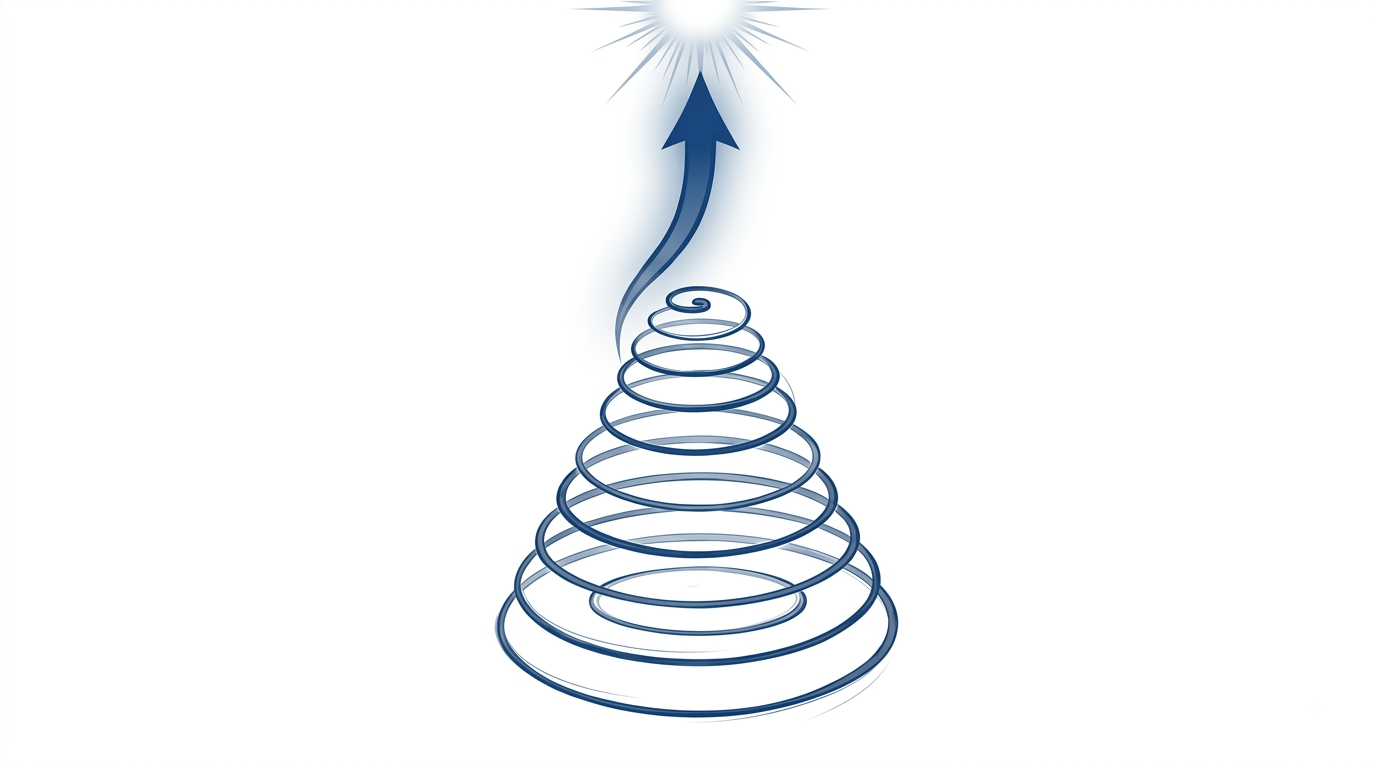
Figure 1: Schematic representation of spiritual evolution: The more attached a person is to transient phenomena, the greater their ego and attraction to worldly things. The more equanimous and spiritual a person becomes, the smaller their ego and the weaker the attraction to worldly things. The dissolution of the ego is achieved when complete spiritual healing and a state of fulfillment have been attained. The cycle of life and death is then overcome. The soul rises above the lowlands of worldly existence and returns to the homeland of all enlightened souls.
Credits: AI, Gemini, May 12, 2026
The perception of time as a linear phenomenon is regarded as a human illusion generated by an unconscious way of life. It is characterized by identification with what can be materially proven or experienced through the senses. Yet the depth of existence is seen precisely in a life-affirming, yet equanimous, transcendence of transient phenomena.
The art of dying while alive
In the wisdom of Sikhi, death is repeatedly used as a metaphor for a continuous state of equanimity. When a person has mastered this art, ego-driven attachments and the desire for fame, wealth, and power have been overcome. Such a person leads a joyful and ethical life, reflects with foresight on the consequences of their own thoughts and actions, and contributes to society wherever needed.
ਹਸੰਦਿਆ ਖੇਲੰਦਿਆ ਪੈਨੰਦਿਆ ਖਾਵੰਦਿਆ ਵਿਚੇ ਹੋਵੈ ਮੁਕਤਿ ॥੨॥ GGS, 522, M.5
ਮੰਦਾ ਮੂਲਿ ਨ ਕੀਚਈ ਦੇ ਲੰਮੀ ਨਦਰਿ ਨਿਹਾਲੀਐ ॥ ਜਿਉ ਸਾਹਿਬ ਨਾਲਿ ਨ ਹਾਰੀਐ ਤੇਵੇਹਾ ਪਾਸਾ ਢਾਲੀਐ ॥ GGS, 474, M.2
A person who has attained this inner maturity is described as someone who has died while alive and is therefore immortal (Jiwan Mukat). For such a person, the end of the world has already taken place, because the illusions of transience have been seen through.
ਜੀਵਨ ਮੁਕਤਿ ਸੋ ਆਖੀਐ ਮਰਿ ਜੀਵੈ ਮਰਿਆ ॥ GGS, 1098, M.5
ਕਬੀਰ ਜਿਸੁ ਮਰਨੇ ਤੇ ਜਗੁ ਡਰੈ ਮੇਰੇ ਮਨਿ ਆਨੰਦੁ ॥ ਮਰਨੇ ਹੀ ਤੇ ਪਾਈਐ ਪੂਰਨੁ ਪਰਮਾਨੰਦੁ ॥੨੨॥ GGS, 1365, Bhagat Kabir
Accordingly, neither a future final judgment nor death itself passes judgment on a human being, but rather their present orientation. In this context, the wisdom of Sikhi emphasizes that cosmic principles operate continuously, at every moment, throughout all existence. These include, on the one hand, the relationship between cause and effect. The individual and collective consequences of thought and action shape one's destiny. On the other hand, they encompass the principle that energy in a closed system can neither be created nor destroyed, but only transformed. Accordingly, nothing in the universe is ever truly lost, materially or spiritually; everything is merely subject to a continuous process of transformation.
ਧਰਮ ਰਾਇ ਨੋ ਹੁਕਮੁ ਹੈ ਬਹਿ ਸਚਾ ਧਰਮੁ ਬੀਚਾਰਿ ॥ ਦੂਜੈ ਭਾਇ ਦੁਸਟੁ ਆਤਮਾ ਓਹੁ ਤੇਰੀ ਸਰਕਾਰ ॥ GGS, 38, M.3
ਜੇਹਾ ਬੀਜੈ ਸੋ ਲੁਣੈ ਮਥੈ ਜੋ ਲਿਖਿਆਸੁ ॥ ਰੈਣਿ ਵਿਹਾਣੀ ਪਛੁਤਾਣੀ ਉਠਿ ਚਲੀ ਗਈ ਨਿਰਾਸ ॥ GGS, 133, M.5
ਨਾ ਕਛੁ ਆਇਬੋ ਨਾ ਕਛੁ ਜਾਇਬੋ ਰਾਮ ਕੀ ਦੁਹਾਈ ॥੧॥ ਰਹਾਉ ॥ ਜੋ ਬ੍ਰਹਮੰਡੇ ਸੋਈ ਪਿੰਡੇ ਜੋ ਖੋਜੈ ਸੋ ਪਾਵੈ ॥ GGS, 695, Bhagat Pipa
In this context, heaven and hell serve as metaphors for states of spiritual consciousness. Hatred and greed, for example, cause people to remain trapped in destructive patterns. Rebirth therefore describes not only an existential transition, but also the recurrence of egotistical patterns. When a person lives in harmony with their spiritual self and the flow of life, trust and joy emerge. This state is described, among other things, as paradise. When a person suffers because, for example, insatiable desires remain unfulfilled, this is described as the torment of hell.
ਮਮਾ ਜਾਹੂ ਮਰਮੁ ਪਛਾਨਾ ॥ ਭੇਟਤ ਸਾਧਸੰਗ ਪਤੀਆਨਾ ॥ ਦੁਖ ਸੁਖ ਉਆ ਕੈ ਸਮਤ ਬੀਚਾਰਾ ॥ ਨਰਕ ਸੁਰਗ ਰਹਤ ਅਉਤਾਰਾ ॥ ਤਾਹੂ ਸੰਗ ਤਾਹੂ ਨਿਰਲੇਪਾ ॥ GGS, 259, M.5
Seasons as an opportunity for self-reflection and awareness of spiritual maturation
An inspiring exercise in self-reflection and in becoming aware of our conditioning, patterns, and inner state of consciousness can be found in the verses of Barh Maha.
ਬਾਰਹ ਮਾਹਾ ਮਾਂਝ ਮਹਲਾ ੫
ਤੁਖਾਰੀ ਛੰਤ ਮਹਲਾ ੧ ਬਾਰਹ ਮਾਹਾ
The verses were revealed to the wise ones Gur Nanak (GGS, 1107–1110, M.1) and Gur Arjan (GGS, 133–136, M.5). They use the familiar character of the seasons as a metaphor for the spiritual evolution of a seeker and describe their experiential world and inner states within the cycle of life. The scorching heat, the life-giving rain, or the bitter cold serve as a mirror for the state of one's own soul on its journey toward fulfillment. These compositions transcend notions of seasons or sacred places. Thus, a cold-hearted egoism represents spiritual desolation in the midst of spring. The coldest winter appears pleasant when unconditional love and wisdom warm the heart. Accordingly, the respective cycle does not end with a date, a season, or at a particular place, but with the level of consciousness attained. From this perspective, a true spring and celebration are described as the time when one intuitively lives in harmony with the flow of life and reaps the spiritual fruits of a virtuous life.
ਨਾਨਕ ਵੈਸਾਖੀਂ ਪ੍ਰਭੁ ਪਾਵੈ ਸੁਰਤਿ ਸਬਦਿ ਮਨੁ ਮਾਨਾ ॥੬॥ GGS, 1108, M.1
ਸਾਈ ਘੜੀ ਸੁਲਖਣੀ ਸਿਮਰਤ ਹਰਿ ਨਾਮ ॥੧॥ ਰਹਾਉ ॥ GGS, 815, M.5
Epistemic colonization of concepts of time and death in Sikhi
Despite these non-dualistic and cyclical insights into time and death, an epistemic colonization, or occupation of the mind, has taken place within Sikhi, resulting in an alienation from its spiritual way of life.
One reason for this is that Sikhs have increasingly faced oppression and persecution because of their unique and sovereign way of life. Sikhs questioned established social dogmas such as the caste system, religious beliefs, ritualized and profit-oriented practices, and violence committed in the name of religion. As a result, the transmission of wisdom was disrupted by the ongoing struggle for survival against Hindu and Muslim rulers and, subsequently, against the British colonizers. The various forms of colonization over the centuries encouraged dogmatism, division, and institutionalization, as well as increasing ritualization and commercialization. Hindu, Muslim, and Abrahamic interpretations and translations increasingly influenced the way of life. Over the course of history, Sikhi was thus reduced to the monotheistic "Sikhism," a syncretic form of warriorhood, or a tradition of singing and meditation (Oberoi, 1994; Mandair, 2009; Mandair, 2013; Bhogal, 2014).
It is important to recognize that conscious or unconscious forms of colonization are not a one-way process. Alienation also takes place in various ways from within. In Sikhi, this is evident, among other things, in the fact that inadequate interpretations and translations, freely accessible online or through apps, dominate globally. Another facet of this alienation becomes apparent when actors portray Sikhi as soulless humanism. In doing so, even the very core of Sikhi, the spiritual divine force that brings forth life, is denied. Human beings are thus presented as random molecular products, with death equated to the breakdown of a biological machine. Social media further amplifies the resulting cacophony and disorientation among adherents. Chatbots based on so-called artificial intelligence, such as ChatGPT, Claude, Copilot, and Gemini, further reinforce dominant discourses, misinterpretations, and literal translations of metaphorical wisdom.
Conclusion
Time is not a neutral constant, but a reflection of worldviews and power structures. The history of humanity suggests that, alongside all their worldly achievements, linear concepts of time encourage people to control and optimize, to view death as a threat, and to treat nature as a resource to be exploited. Cyclical perspectives, by contrast, appear to encourage us to see ourselves more as guests on Mother Earth, to recognize becoming within passing away and transition within death, and to view nature as a living organism interconnected with all its inhabitants and deserving of respect. Complementary perspectives, such as those outlined in this essay, can help expand linear growth models through more holistic approaches, thereby reducing the long-term damage caused by our actions to ourselves, the animal world, and nature. A cyclical worldview encourages us to listen and observe. It fosters humility and balance. Ultimately, it reminds us: Everything returns to its source.
The river water flows.
Navigates every obstacle.
Flows into the ocean.
River and ocean were two.
And yet they were always one.
References
Adam, B. (1990). Time and Social Theory. Cambridge: Polity Press.
Attia, P. & Gifford, B. (2023). Outlive: The Science and Art of Longevity. New York: Harmony Books.
Bhogal, B. S. (2014). Postcolonial and Postmodern Perspectives on Sikhism. In P. Singh & L. E. Fenech (Eds.), The Oxford Handbook of Sikh Studies (pp. 282–297). Oxford: Oxford University Press.
Borst, A. (1990). Computus: Zeit und Zahl in der Geschichte Europas. Berlin: Wagenbach.
Christian, D. (2018). Origin Story: A Big History of Everything. New York: Little, Brown and Company.
Comaroff, J. & Comaroff, J. (1991). Of Revelation and Revolution: Christianity, Colonialism, and Consciousness in South Africa. Chicago: University of Chicago Press.
Emiliani, C. (1993). Calendar Reform. Nature, 366(6457), p. 716.
Ende, M. (1973). Momo. Stuttgart: Thienemann.
Ettinger, R. C. W. (1962). The Prospect of Immortality. New York: Doubleday.
Fanon, F. (1967). Black Skin, White Masks. New York: Grove Press.
Goswami, A., Reed, R. E. & Goswami, M. (1993). The Self-Aware Universe: How Consciousness Creates the Material World. New York: Jeremy P. Tarcher/Putnam.
Guru Granth Sahib. (n.d.). www.sikhi.eu/s/GuruGranthSahib_Gurmukhi_Index_Unicode.pdf. May 12, 2026.
Haidt, J. (2024). The Anxious Generation: How the Great Rewiring of Childhood Is Causing an Epidemic of Mental Illness. New York: Penguin Press.
Hall, E. T. (1983). The Dance of Life: The Other Dimension of Time. New York: Anchor Press.
Helliwell, J. F., Layard, R., Sachs, J. D., De Neve, J.-E., Aknin, L. B. & Wang, S. (Eds.) (2026). World Happiness Report 2026. Oxford: Wellbeing Research Centre, University of Oxford.
Knoll, A. H. (2003). Life on a Young Planet: The First Three Billion Years of Evolution on Earth. Princeton: Princeton University Press.
Mandair, A.-P. S. (2009). Religion and the Specter of the West: Sikhism, India, Postcoloniality, and the Politics of Translation. New York: Columbia University Press.
Mandair, A.-P. S. (2013). Sikhism: A Guide for the Perplexed. London: Bloomsbury Academic.
Mbiti, J. S. (1969). African Religions and Philosophy. London: Heinemann.
More, M. (2013). The Philosophy of Transhumanism. In M. More & N. Vita-More (Eds.), The Transhumanist Reader (pp. 3–17). Oxford: Wiley-Blackwell.
Mudimbe, V.-Y. (1988). The Invention of Africa: Gnosis, Philosophy, and the Order of Knowledge. Bloomington: Indiana University Press.
Nanni, G. (2012). The Colonization of Time: Ritual, Routine and Resistance in the British Empire. Manchester: Manchester University Press.
Needham, J. (1959). Science and Civilisation in China. Vol. 3: Mathematics and the Sciences of the Heavens and the Earth. Cambridge: Cambridge University Press.
Ngũgĩ wa Thiong'o (1986). Decolonising the Mind: The Politics of Language in African Literature. London: James Currey.
Oberoi, H. (1994). The Construction of Religious Boundaries: Culture, Identity, and Diversity in the Sikh Tradition. Chicago: University of Chicago Press.
Pannenberg, W. (1993). Systematische Theologie. Vol. 3. Göttingen: Vandenhoeck & Ruprecht.
Richards, E. G. (1998). Mapping Time: The Calendar and Its History. Oxford: Oxford University Press.
Rosa, H. (2005). Beschleunigung: Die Veränderung der Zeitstrukturen in der Moderne. Frankfurt am Main: Suhrkamp.
Rovelli, C. (2021). Helgoland. Hamburg: Rowohlt.
Rushkoff, D. (2013). Present Shock: When Everything Happens Now. New York: Current.
Said, E. W. (1978). Orientalism. New York: Pantheon Books.
Shiva, V. (1993). Monocultures of the Mind: Perspectives on Biodiversity and Biotechnology. London: Zed Books.
Steel, D. (2000). Marking Time: The Epic Quest to Invent the Perfect Calendar. New York: Wiley.
Wajcman, J. (2015). Pressed for Time: The Acceleration of Life in Digital Capitalism. Chicago: University of Chicago Press.
Wittmann, M. (2016). Felt Time: The Science of How We Experience Time. Cambridge: MIT Press.
Source: This paper is a translation of the following publication: Singh, Khushwant (2026). Zeitvorstellungen in der Sikhi: Momo, Linearität, Kolonisierung und die Kunst der Zirkularität. In: Al-Mustafa Institut (Hrsg.): The Turn. Internationale Zeitschrift für Islamische Philosophie – Theologie – Mystik. Heft 2-2026, Ausgabe 10 (S. 89-105).