Religious Freedom in Uniform: Strengthening Minority Participation in State Services – The Case of Sikhs in the German Armed Forces
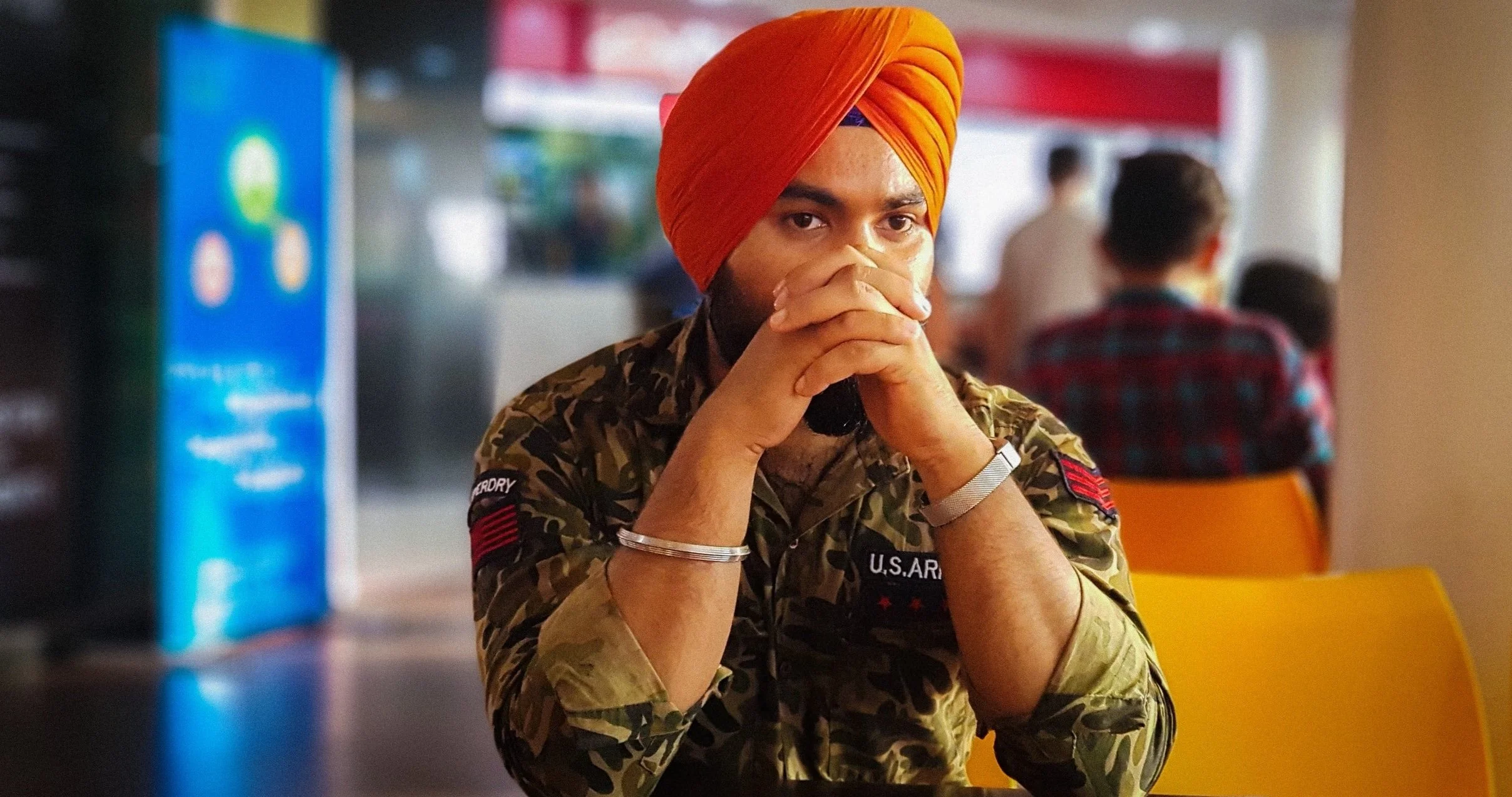
This article by Khushwant Singh explores how the participation of minorities such as Sikhs in public service can be strengthened. Using the example of the new military defense service in the German Bundeswehr, it highlights the principles of religious freedom, international practice, and legal foundations, with a focus on the turban (Dastar) and the sword of wisdom (Kirpan). The Dastar adorns the uncut hair of Sikhs. It expresses naturalness, humility, devotion, loyalty and a virtuous life. Sikhs wrap it anew every day and wear it with dignity - also at work. The picture shows a Sikh serving in the American army. In the USA, Canada, Great Britain and India, Sikhs, along with their turban and the sword of wisdom, the kirpan, are a natural part of the civil service. There they work in schools, courts, the police and the armed forces.
Credits: Unsplash
Reflections on religious freedom and military service in the 21st century - Paths to equal participation
The following text draws on examples related to the development of German Bundeswehr's new military service model to show how a legally secure participation of minorities such as the Sikhs in national service can be strengthened. A corresponding letter was sent to Defense Minister Boris Pistorius on September 12, 2025. Thomas Rachel, Member of the German parliament and Federal Government Commissioner for Freedom of Religion or Belief, supports the cause. The positive response from the Federal Ministry of Defense, issued on behalf of the Federal Minister, is attached in excerpts at the end of this article. As a result, a practicing Sikh from the Rhine-Main region was successfully enlisted in the German Armed Forces Bundeswehr and has since taken his oath (see Instagram post).
Basics of Sikhi
Sikhi, the journey of life-long spiritual learning, evolved in the Panjab region from the 15th century onwards in today’s North India and Pakistan. It inspires about 25 million Sikhs worldwide and around 35,000 in German-speaking countries. This young world religion - often referred to as the Sikh religion or Sikhism - has unique traditions, including its own poetic script-language (Gurmukhi), naming conventions, and devotional recitation style and noble attire. Sikhi draws on timeless spiritual wisdom (Gurmat) revealed to over 30 Enlightened Ones, which has been preserved until today (Gurbani). Sikhi views all sentient beings as part of one family. Its wisdom helps reflecting upon childhood imprints and the estrangement from divinity. Gurmat thus paves the way to distinguish natural needs from desires, transcend the diaspora of ephemerality, embrace a cyclical worldview while living a dignified, ethical, healthy, and spiritual life in harmony with nature and the Divine.
The SikhiCouncil
The SikhiCouncil is a voluntary initiative. Grounded in the unifying and community-oriented insights of Sikhi, the Council fosters exchange among Sikhs and promotes interreligious dialogue. It is committed to a healthy, dignified, and ethical way of life in harmony with nature, to peaceful coexistence, and to freedom of religion and belief (FoRB). In line with the global Sustainable Development Goals (SDGs) of the United Nations Agenda 2030, the SikhiCouncil focuses on wellbeing, education, environmental protection, peace and justice, and partnerships. It serves as a point of contact for media, educational and health institutions, as well as public authorities. The SikhiCouncil's cooperation partners include the Global Ethic Foundation (Stiftung Weltethos), the Foundation against Racism and The Frankfurt Council of Religions.
The new military service model - An opportunity for greater resilience
The German government's initiative for a new military service model through voluntary military service can strengthen the resilience of the Bundeswehr in volatile times and mobilise the existing resources of the population in order to ensure the necessary defence capability of Germany and Europe. It is crucial to include all population groups and not exclude anyone.
Exclusion of Sikhs because of the turban - Religious freedom under pressure
However, it has repeatedly become known that Sikhs in particular are being denied entry into the Bundeswehr - generally on the grounds that wearing a turban is incompatible with military service. There is currently a case from Frankfurt and Mainz, among others. The turban, which covers the uncut hair, is an integral part of being a Sikh. The turban symbolises humility, devotion and loyalty. It has also been proven to offer protection against injury, heat and cold; in addition, there are special, particularly sturdy turban techniques such as the Dumala, which can also incorporate iron chains, for protective purposes. It needs to be noted that the turban is not worn to promote one's own way of life, especially as the Sikh religion rejects proselytising as a matter of principle.
International examples - Living diversity in the civil service and historical merits of Sikhs in the allied armed forces
In the United Kingdom, Canada, the United States of America, India and other countries, the wearing of the turban in the military, police, education, courts and other areas of government service and international organisations has long been established and accepted. There, Sikhs are an integral part of the armed forces and serve in uniform with a turban and their uncut beard.
One example is Canada’s former Minister of Defence, Harjit Singh Sajjan, a Sikh who previously served as Commander of the British Columbia Regiment. The current President of the World Bank, Ajaypal Singh Banga, is also a Sikh. Manmohan Singh was a respected Indian economist and served as India’s Finance Minister in the 1990s. He is regarded as the architect of India’s economic reforms. From 2004 to 2014, he was the first Sikh to serve as Prime Minister of India. He was widely respected around the world for his competence, integrity, and humility. In all of these cases, wearing the turban and the traditional symbolic kirpan has in no way a detrimental effect on their loyalty to their respective countries or employers, nor has it impacted their operational readiness or institutional effectiveness.
Core values such as respect for human dignity, commitment to freedom, peace, and justice - as well as solidarity, loyalty, and courage - are at the heart of Sikhi. These same principles are fundamental to public service and are upheld by the Bundeswehr, NATO, and defense forces worldwide. In fact, there is a long tradition of equal participation of Sikhs in public service and the military. Sikhs served in large numbers in the Allied forces during the First and Second World Wars. They were and still are highly valued for their loyalty, discipline and commitment. In 2015, the Sikh Memorial was unveiled in London's Green Park. It honours the extraordinary contribution of several hundred thousand Sikh soldiers in the First and Second World Wars and commemorates their courage, sacrifice and loyalty.
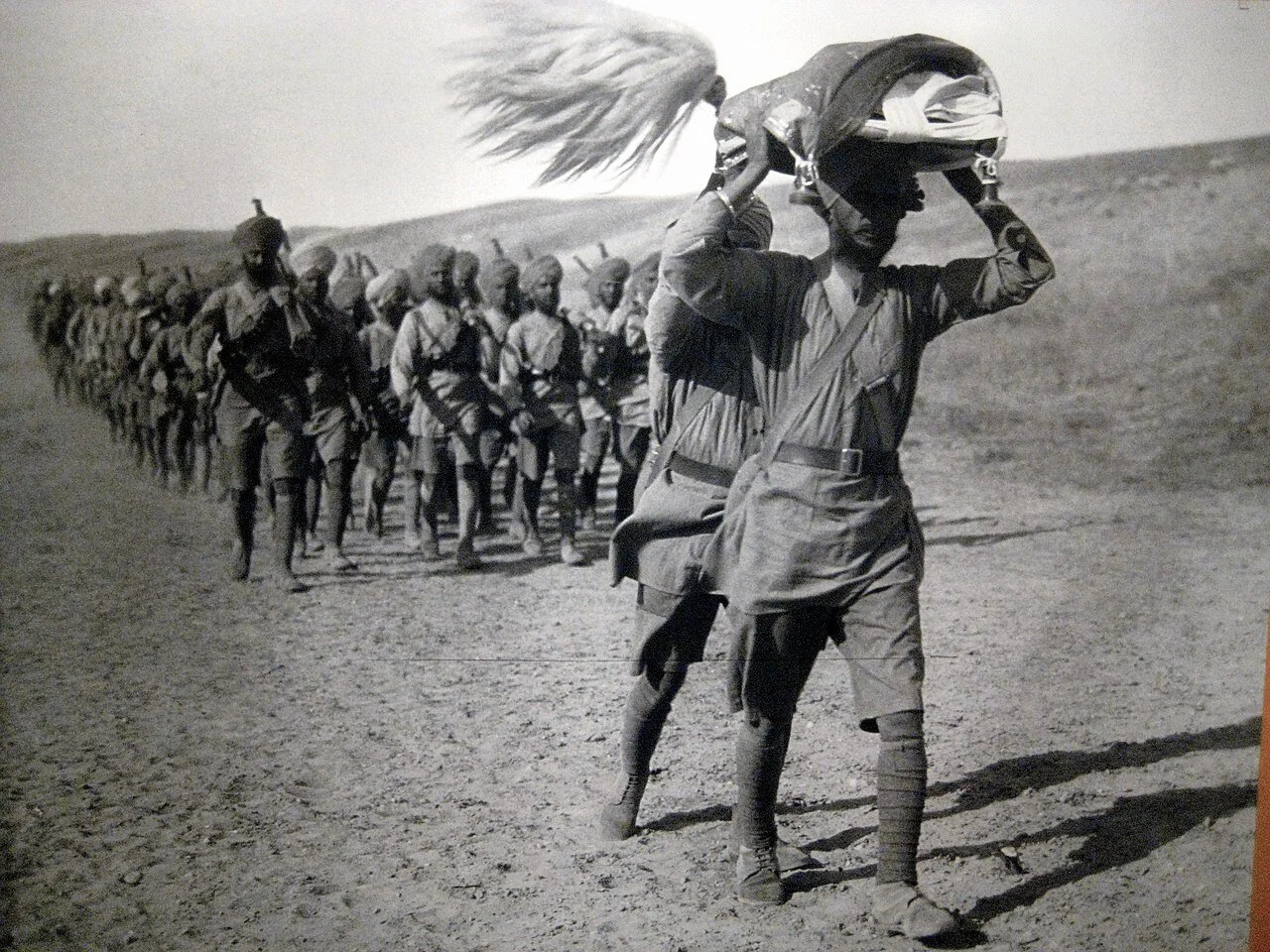
Sikh soldiers in 1918 during the First World War. The Guru Granth Sahib, the collection of timeless spiritual wisdom that is at the heart of Sikhi, is carried with respect above the head. Credits: Wikipedia
Sikhs between lived responsibility and restrictions on their religious freedom
Sikhs are nevertheless experiencing challenges and restrictions in their religious practice, also in Europe, especially because of the turban but also with regard to the symbolic small sword, the Kirpan. Initiated Sikh role models who belong to the Khalsa take an oath to strengthen solidarity and responsibility, to stand up for peace, the common good and those who cannot defend themselves. This attitude is symbolised by the sword of wisdom.
The fact that new regulations or ordinances have currently been issued in some federal states in Germany - for example in the area of public transport or at schools - which also restrict the wearing of a religious symbol such as the kirpan even in public spaces, leads to further disproportionate encroachments on the freedom of religion protected by constitutional and human rights. This is particularly evident from the fact that no cases are known to date in which Sikhs have in any way caused harm to society by wearing their religious symbols.
Legal situation - Protection under the Basic Law, the European Court of Human Rights (ECtHR) and international agreements
The practice in Germany of not accepting practising Sikhs per se into the civil service, whether as teachers, judges or soldiers, does not meet the requirements of a potential-orientated democratic society in the 21st century. It clearly violates Article 1 (human dignity) and Article 4 (freedom of religion) of the Basic Law and is also a violation of the General Equal Treatment Act (AGG). Freedom of religion ensures equal participation of all people in state life and work. The constitutional principle must not be undermined by one-sided and discriminatory interpretations of regulatory provisions.
The constitutionally guaranteed freedom of religion (Article 4 (1) and (2) of the Basic Law) in Germany and the prohibition of discrimination enshrined in the Basic Law (Article 3 of the Basic Law) are substantiated by relevant judgements. The Federal Constitutional Court has repeatedly emphasised that religious clothing and symbols must also be respected in the public sector as long as there is no specific threat to the functioning or neutrality of the state (BVerfG, decision of 27 January 2015 - 1 BvR 471/10, 1 BvR 1181/10, "Kopftuch II"). Blanket bans were expressly categorised as unconstitutional; a restriction is only permissible if there is a demonstrable, specific threat. These principles apply equally to the turban and the Kirpan, the religious significance of which must be taken into account in the context of the constitutionally protected freedom of belief and confession.
Freedom of religion is also clearly protected at European level. The European Court of Human Rights (ECtHR) has repeatedly stated that interference with the practice of religion is only permissible under strict conditions (ECtHR, judgement of 15 February 2001 - Dahlab v Switzerland; ECtHR, judgement of 15 January 2013 - Eweida and others v United Kingdom). In the Eweida case, the ECtHR affirmed a violation of Art. 9 ECHR and demanded a fair balancing of business interests and individual religious practice. In addition, Art. 10 of the EU Charter of Fundamental Rights guarantees freedom of religion, while the EU Anti-Discrimination Directive 2000/78/EC prohibits both direct and indirect discrimination based on religion. In the case of Ranjit Singh v France (CCPR/C/102/D/1876/2009, 22 July 2011), the UN Human Rights Committee confirmed that a ban on turbans in ID photos constitutes a violation of Art. 18 of the ICCPR.
The legal situation and the available judicial interpretations make it clear that blanket bans on religious symbols - such as the turban or the Kirpan - without differentiated and proportionate consideration constitute a violation of applicable national and international law.
Comparative examples - Good practices from other democracies
European comparative examples show practicable solutions: For example, the United Kingdom expressly provides exemptions for the wearing of the kirpan "for religious reasons" in Section 139(5)(b) of the Criminal Justice Act 1988. The Court of Appeal in Antwerp (12.10.2009; 1204 P 2007) has recognised the kirpan as a religious symbol. Finally, the Supreme Court of Canada, in its landmark Multani judgement (2006 SCC 6, 1 S.C.R. 256), also permitted the wearing of the kirpan in schools subject to proportionate safety conditions - a much-cited example of interculturally appropriate and sustainable solutions instead of blanket bans.
This shows that viable solutions can be found in a democratic and human rights-orientated society. Especially when consultative and consensus-oriented legislative processes take place with the involvement of experts and potentially affected parties, and court decisions are made that take minority rights - including the interests of religious minorities - into account before regulation takes place or new laws are passed that are applied across the board.
Equating a religious head covering with an inability to perform official duties lacks any basis and has long since been overcome in many democracies. Against this background, an adjustment of the current practice in Germany and other countries is appropriate and overdue.
Social consequences of discrimination - Risk of alienation
The current discriminatory incidents are not only undermining trust in the federal government and state authorities, but also the feeling of belonging to Germany as a homeland. After repeated marginalising experiences, adolescents in particular are demonstrably turning away from their home country - in this case Germany - and its politics, emigrating or becoming radicalised. Experiences that lead to social marginalisation also run counter to the goals of the German government: the planned increase in troop strength to around 260,000 soldiers by 2035 and the focus on national and alliance defence is only possible with an inclusive approach where the potentials of the inhabitants is at the center. This requires comprehensive restructuring, modernisation and the introduction of a new and inclusive military service model that strengthens the ability for sustainable growth and resilience.
Need for action - Concrete steps to strengthen participation
There is an urgent need for action to strengthen trust and to initiate interculturally adapted measures that eliminate the imbalances discussed above for the benefit of the Federal Republic of Germany and the EU. It is essential to overcome delays resulting from the diffusion of responsibilities and competences and instead implement concrete steps and decrees in a timely manner that will be felt in everyday and professional life - including for minorities - throughout Germany. It is necessary to initiate an institutionalised, inclusive and interculturally appropriate procedure for the fundamental regulation of religious symbols in military service - and to develop transparent guidelines that reconcile religious freedom and the ability to serve in the military, as well as to establish public relations work that emphasises (religious) diversity as a strength and not a weakness.
Inclusion and minority rights as a litmus test for the new military service
The voices of smaller groups and minorities are becoming increasingly important, especially in times when the formation of political majorities is becoming more challenging due to growing party diversity and social polarisation. It is therefore all the more important to work together to ensure that their concerns are heard. In this way, disenchantment with politics can be prevented and at the same time a climate of solidarity and democratic participation can be strengthened.
Based on the above considerations and suggestions, a respectful negotiation process with the decision-makers in the Ministry of Defence as well as with other relevant bodies of the Federal Government, Parliament and the relevant committees and commissioners (including the Interior and Homeland, Legal Affairs, Human Rights, Commissioner for the Armed Forces, Federal Government Commissioner for Global Freedom of Religion, Anti-Discrimination Agency) would be appropriate. The aim would be to develop a sustainable and legally secure practice for dealing with religious practices and symbols of minorities, including in military service.
With determination and courage, it will be possible to work together to develop solutions that strengthen the sense of community and responsibility across all groups of citizens - especially in the face of growing right-wing extremist tendencies and social fragmentation in Germany and other European countries. The practice of recruitment for military service represents a litmus test in this respect.
Letter from the Federal Ministry of Defense
On February 6, 2026, the Federal Ministry of Defense (Directorate Law III 4) responded to the concerns raised as follows:
“The Bundeswehr places particular emphasis on recognizing the diversity present in society – which significantly shapes political, social, cultural, and economic life in Germany – and on making use of this diversity as part of its commitment to being an attractive employer. At present, a statutory ordinance is being prepared within the Federal Ministry of Defense to regulate the external appearance of soldiers while performing their duties and in activities with a direct connection to service. In this context, we will take your concerns into account and examine to what extent the provisions of this ordinance on the appearance of soldiers can be designed in such a way that members of your religious community are also able to serve in the Bundeswehr.”